How to Size a 48 V DC Feeder: Voltage Drop, Loss, and Current Density
A worked 48 V DC feeder example showing conductor resistance, voltage drop, I²R loss, current density, and why those checks do not replace code ampacity.
Explore browser-based engineering, mathematics, physics, chemistry, and science tools for students, educators, and technical projects. No account is required, calculations run locally in your browser, and the engineering models publish their equations, assumptions, limitations, and references.
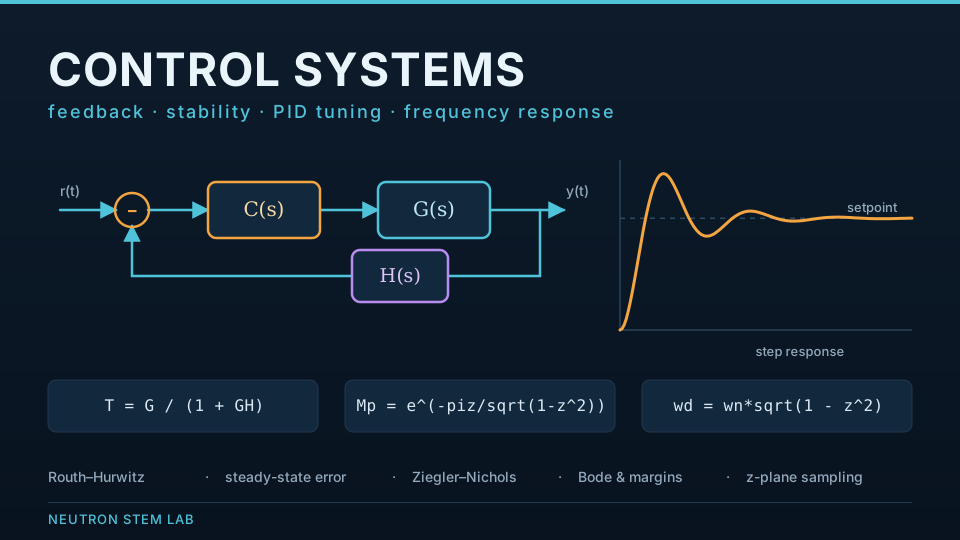
Build block diagrams, tune continuous or digital PID controllers, simulate transfer-function and state-space plants, and inspect step response, Bode behavior, poles, gain/phase margins, and controller effort directly in your browser.
Free to use · No account · No installation · Browser-local calculations
The Virtual Engineering Labs combine instrument setup, measurements, theory, validation, and engineering interpretation. Practice with an oscilloscope, function generator, multimeter, and bench supply, then explore RC/RL/RLC circuits and measurement error.
Free to use · No account · Browser local · Transparent assumptions
Work through automatically graded conceptual questions, compare measurements with equations, and export your setup and results. Experiments use reproducible settings and support light and dark themes.
A curated cross-section of the full library. Use the directory when you need a specific discipline, equation, or design workflow.
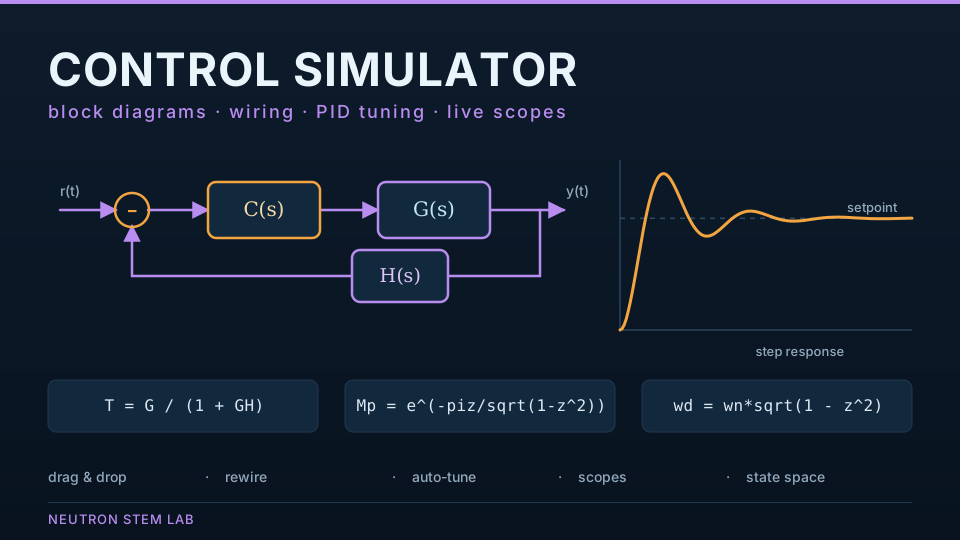
Free browser-based control system simulator with block diagrams, PID tuning, transfer functions, state-space models, step response and Bode analysis. No account or installation required.
Open tool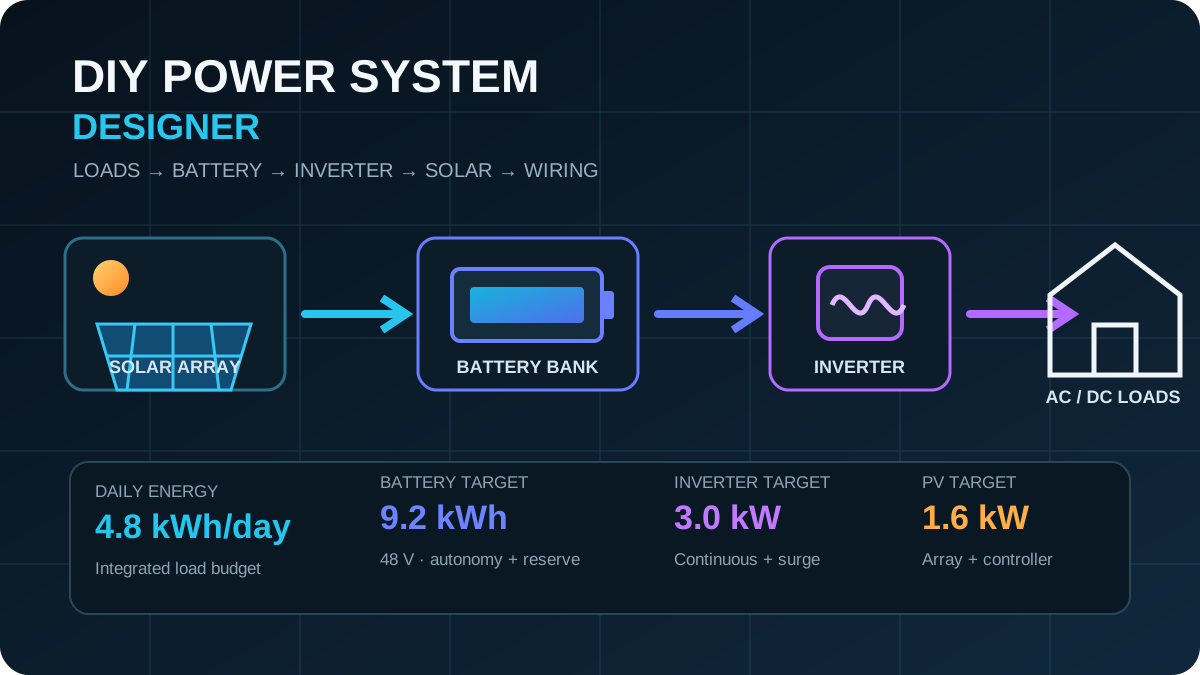
Plan, simulate, document, and export a small off-grid, backup, mobile, workshop, or experimental power system from one shared load list: compare 12 V/24 V/48 V/higher-voltage DC architectures; screen…
Open tool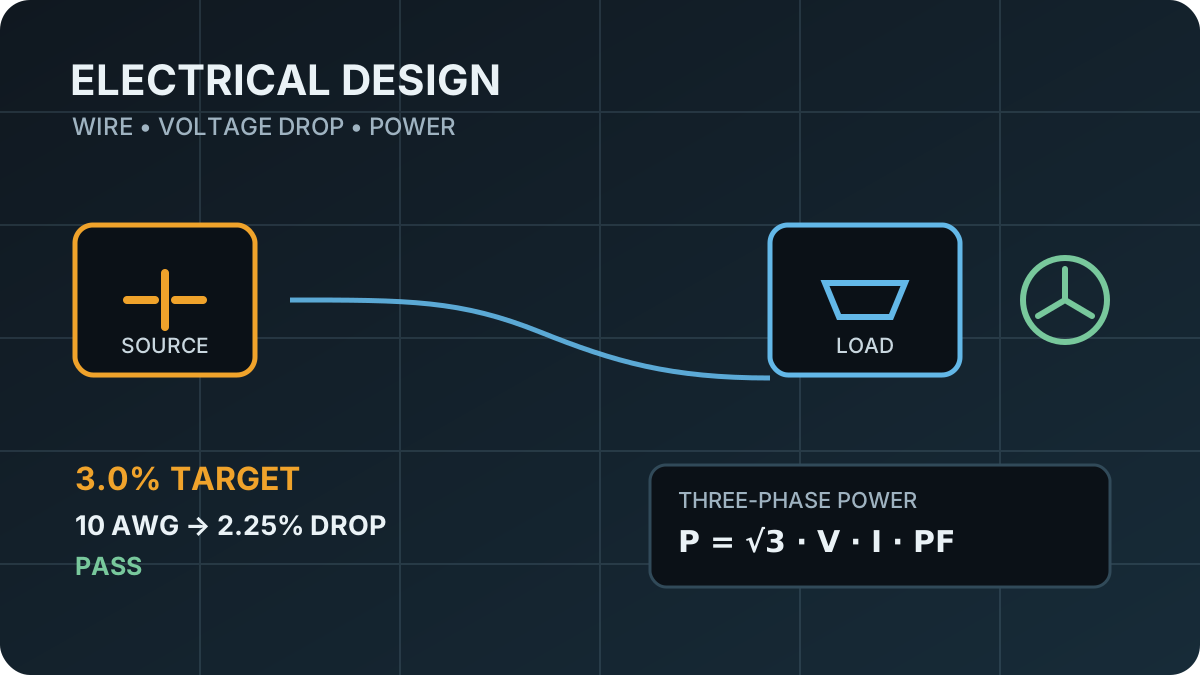
Size and compare conductors, calculate voltage drop and cable loss, and solve DC, single-phase, and balanced three-phase power without jumping between reference charts.
Open tool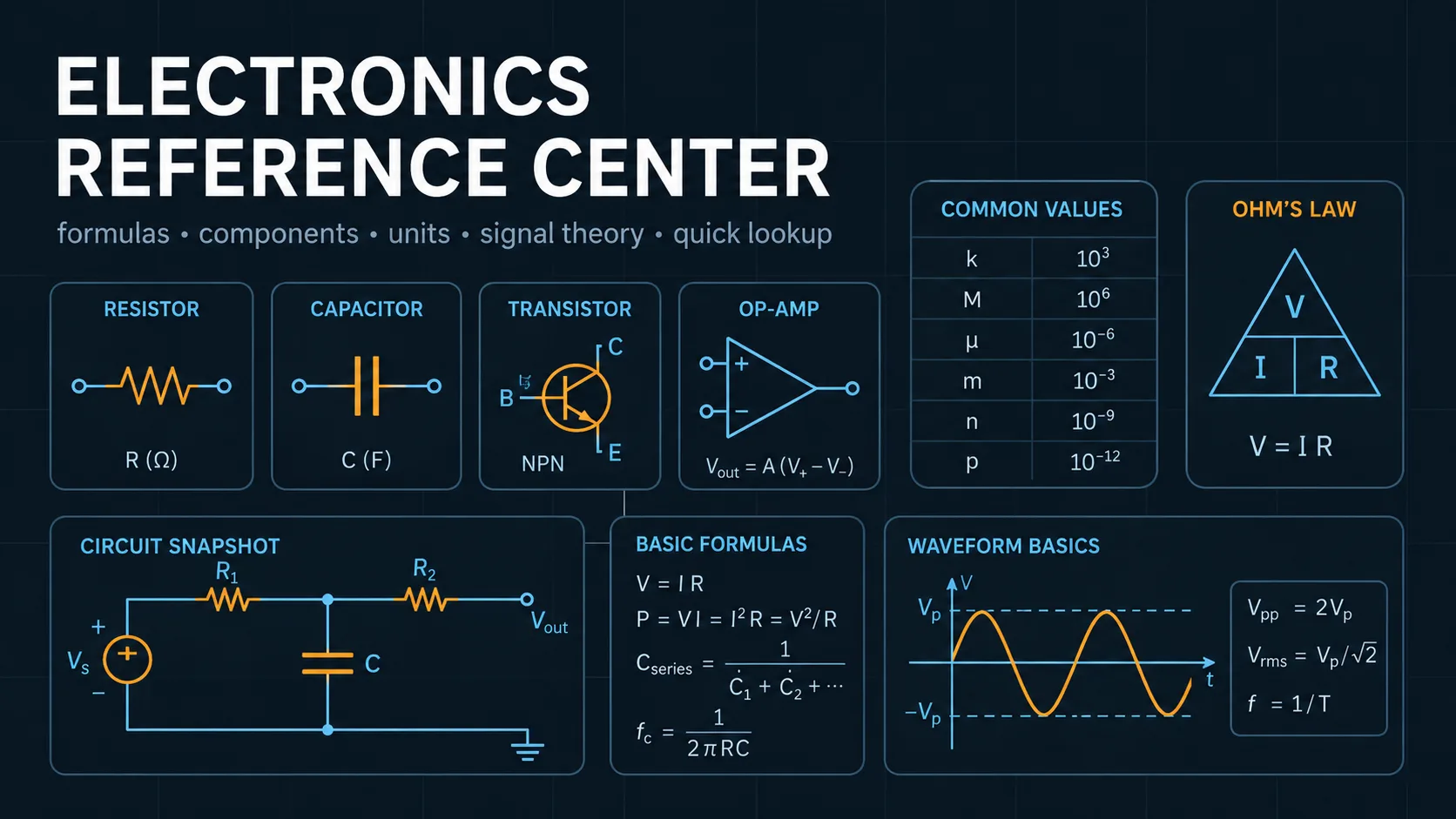
Browse major electronic component families, compare curated real parts with manufacturer datasheets, assemble guided reference circuits, and use an interactive functional circuit builder with drag…
Open tool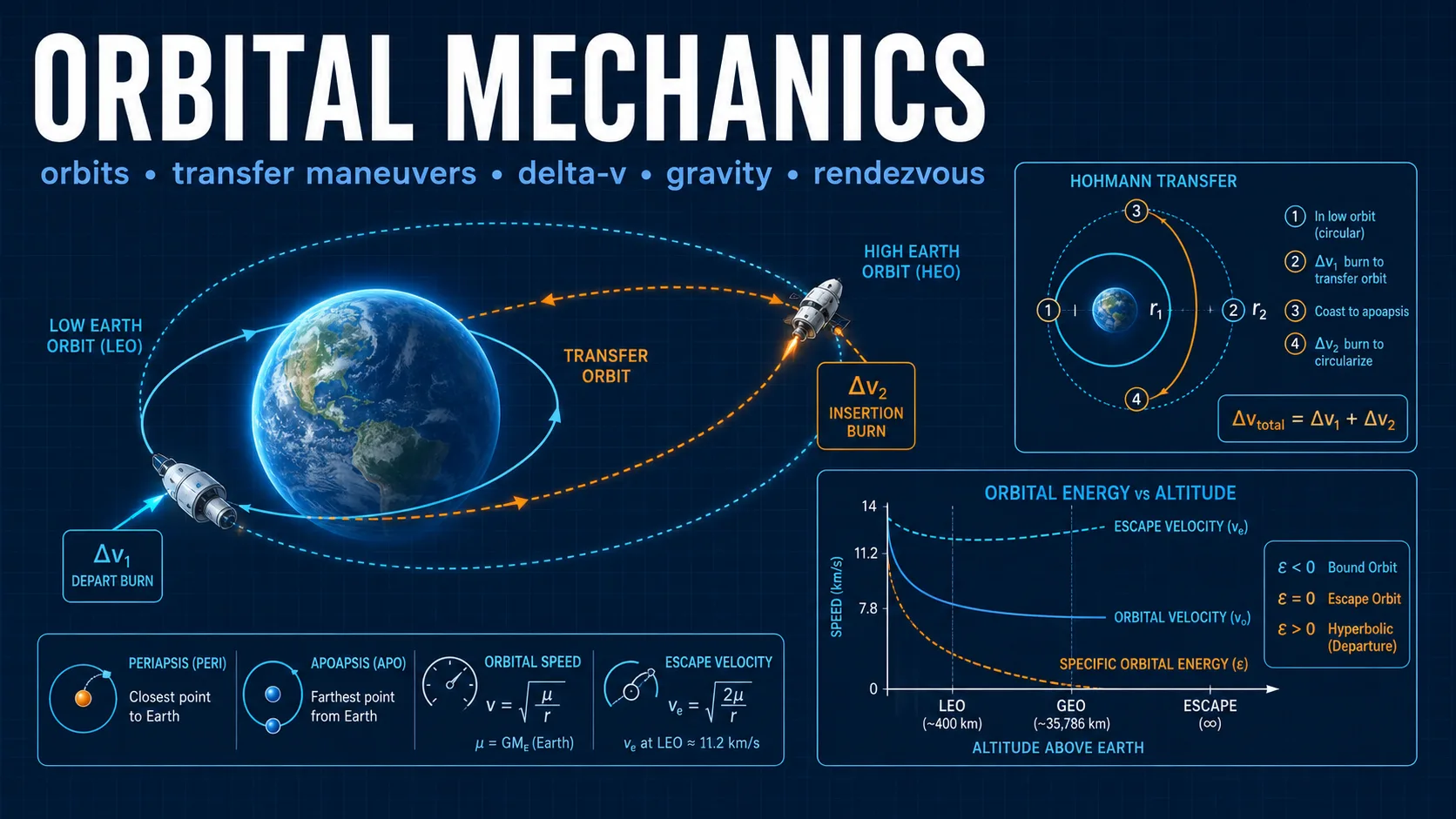
Free browser-based orbital mechanics simulator for propagating spacecraft trajectories around Earth, the Moon, Mars, Jupiter, the Sun, or a custom central body.
Open tool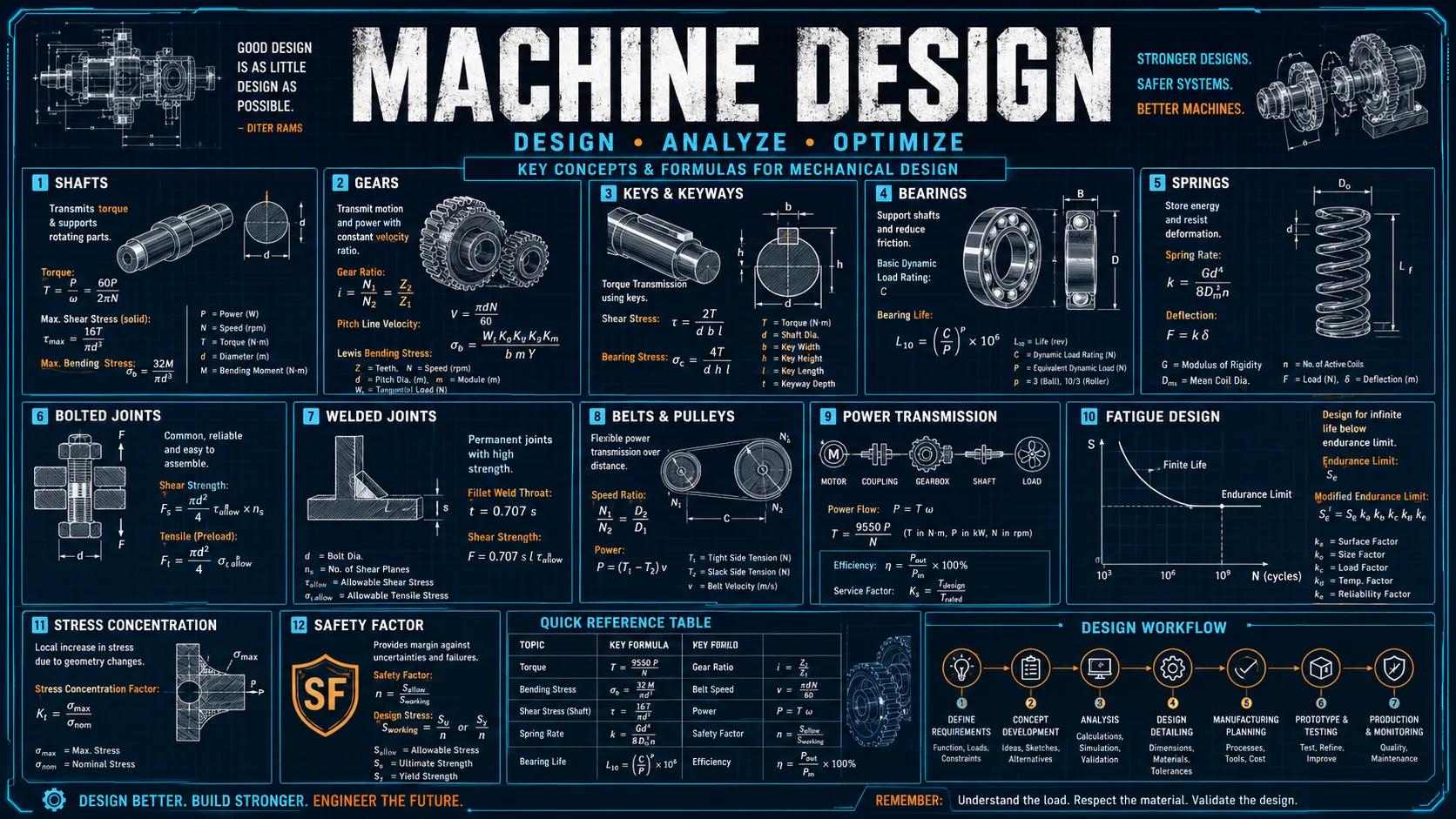
Free browser-based mechanical gear train simulator for spur, compound, internal, and planetary gear systems. Explore speed ratio, rotation direction, torque multiplication, mesh velocity, and basic…
Open tool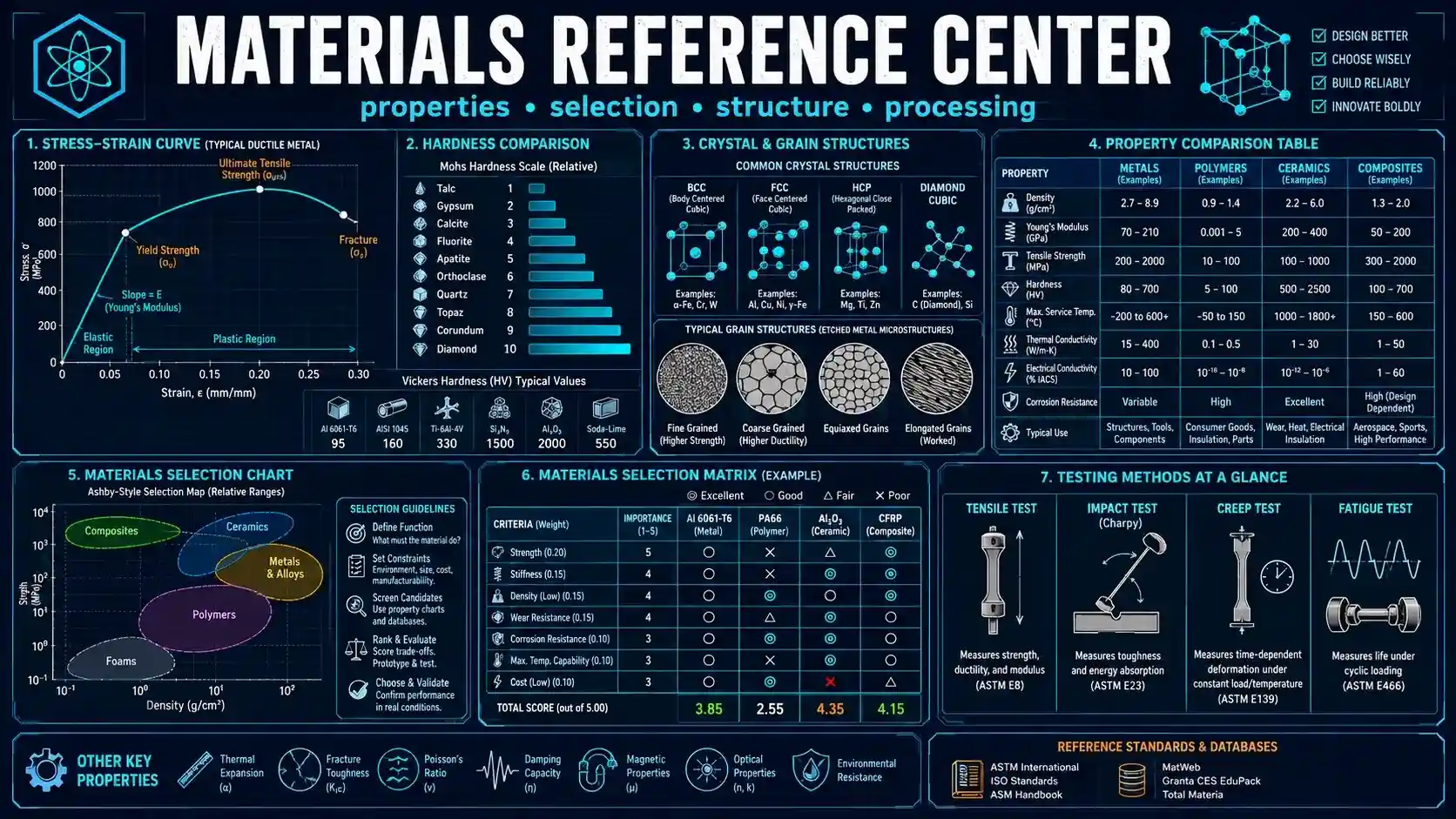
Free browser-based 3D crystal and molecular lattice viewer for common materials structures and custom unit cells. Inspect SC, BCC, FCC, HCP, diamond, ionic, semiconductor, ceramic, graphene, and…
Open tool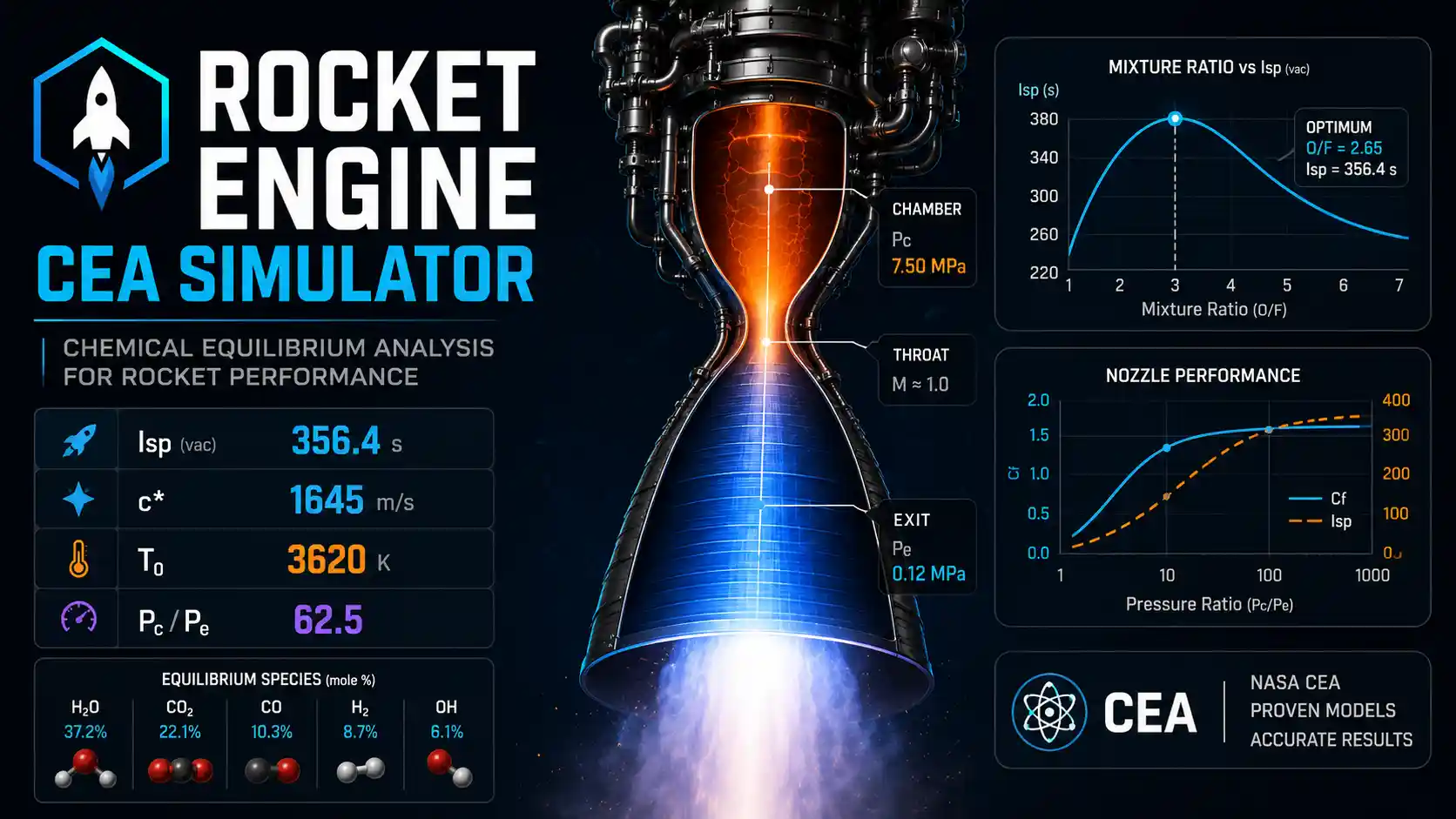
Solve rocket engine performance from chemical equilibrium: adiabatic flame temperature, product composition, characteristic velocity, thrust coefficient, and specific impulse for real propellant…
Open tool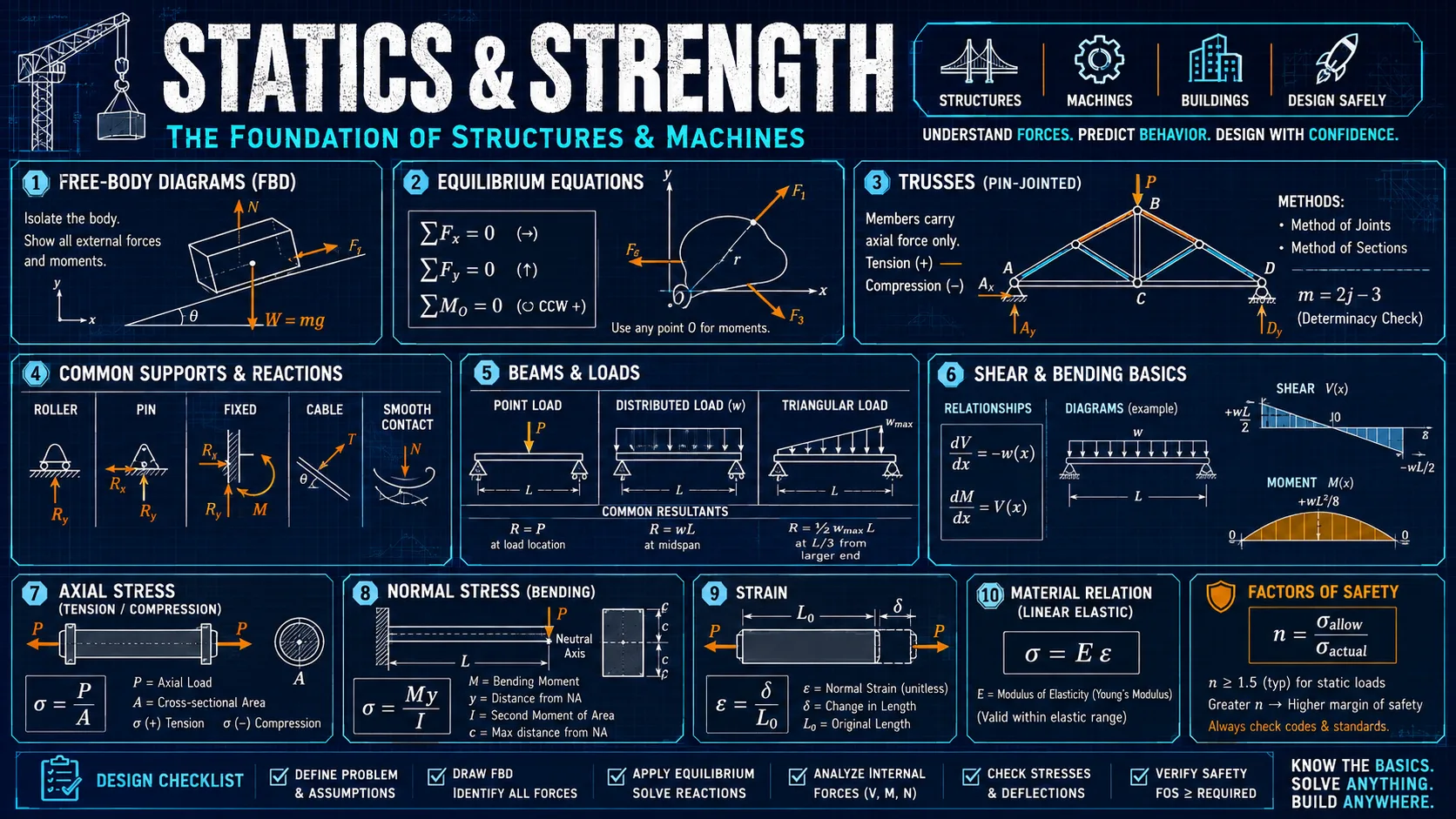
Sixteen modules covering free-body diagrams, support reactions, method of joints, section properties, shear and moment diagrams, bending and shear stress, axial load, torsion, thermal stress…
Open toolFree control systems calculators for PID tuning, transient response, stability, root locus, Bode plots, state-space methods, and digital control.
Open tool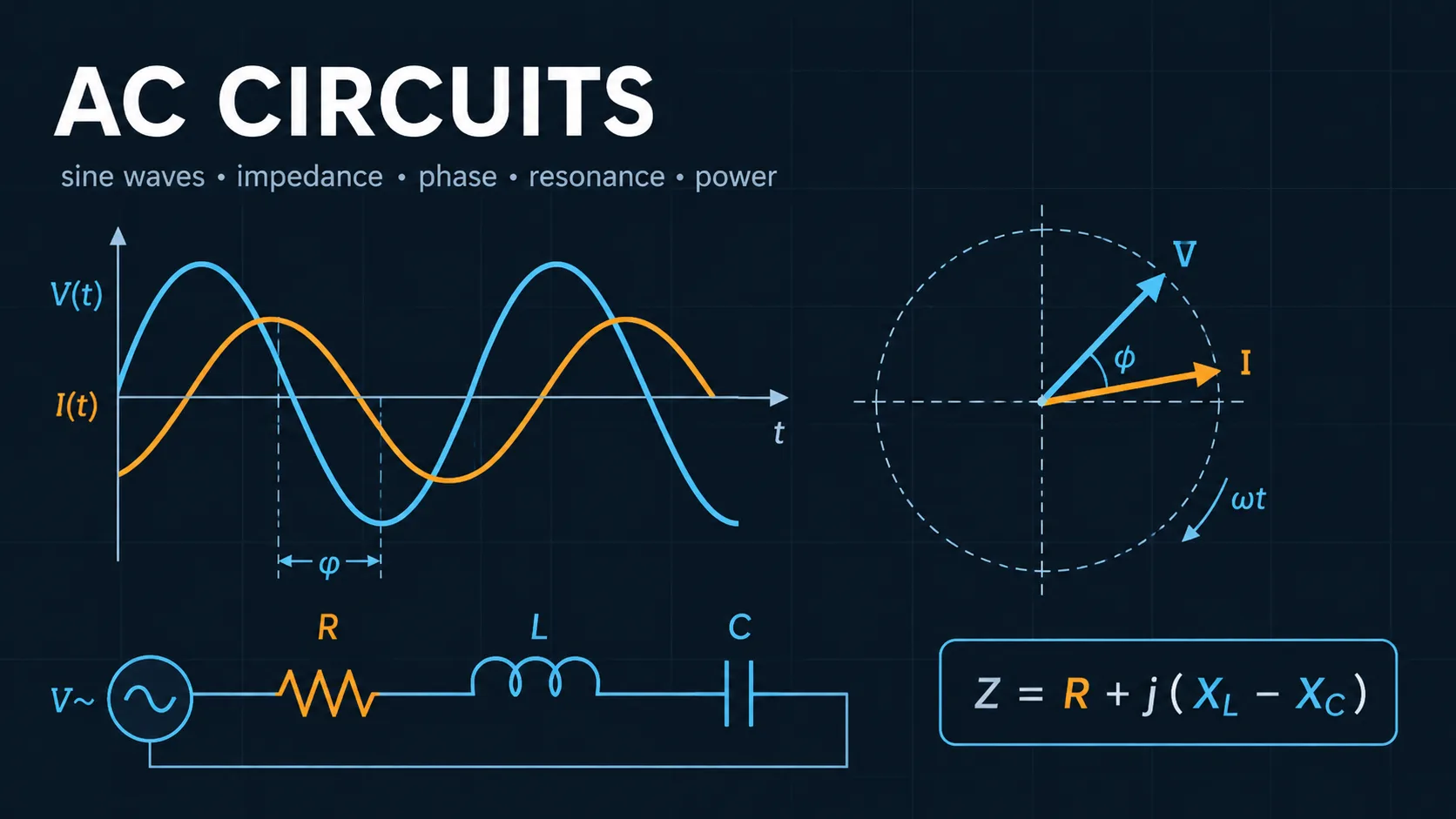
Free AC circuit calculators for impedance, phasors, RLC circuits, resonance, real and reactive power, power factor, transformers, and frequency response.
Open tool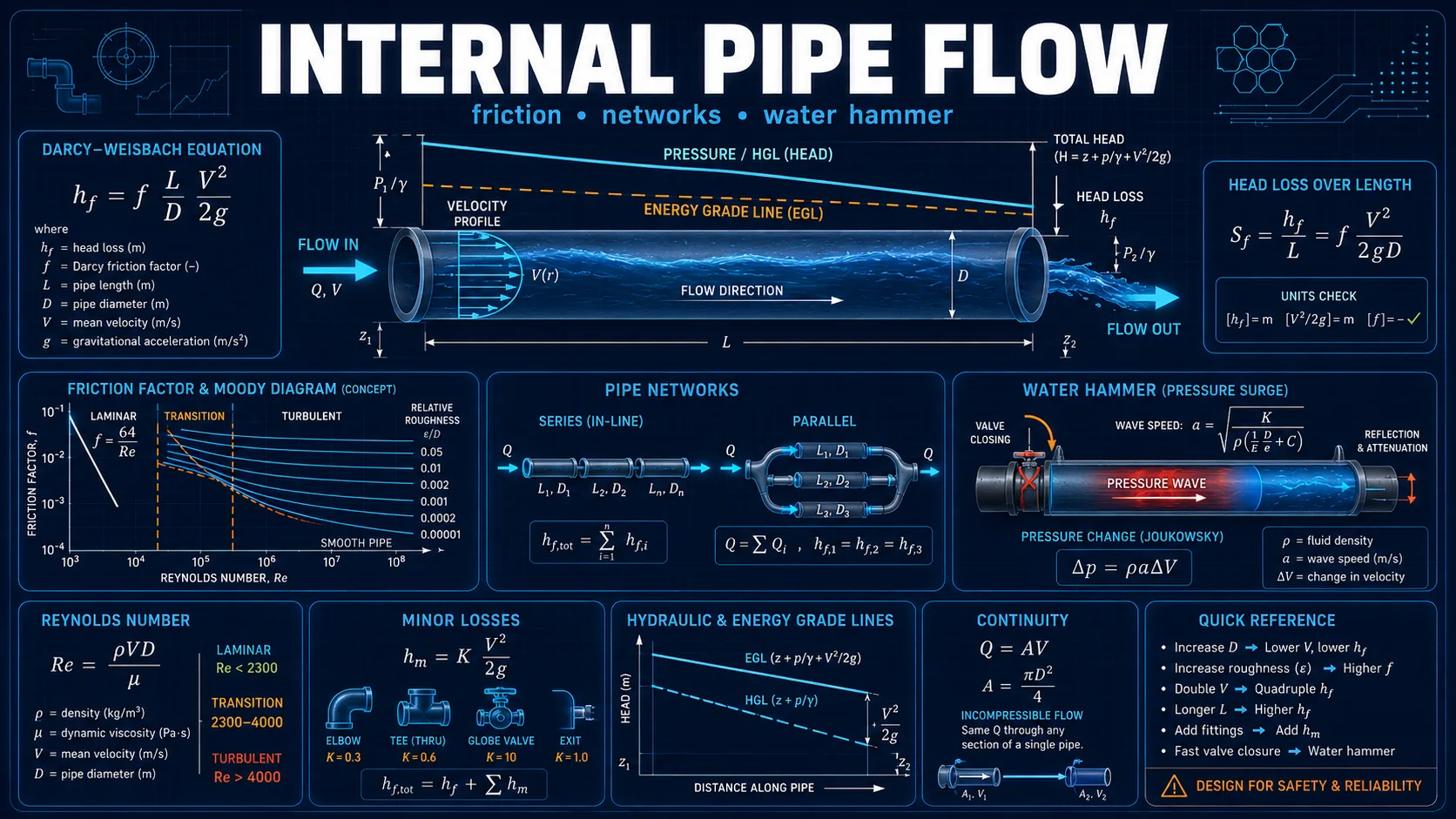
Free pipe flow calculators for Reynolds number, Darcy-Weisbach head loss, friction factor, minor losses, pipe sizing, parallel pipes, and water hammer.
Open toolThese editorial guides expose the equations, intermediate calculations, interpretation, sanity checks, and model limitations behind representative engineering problems.
A worked 48 V DC feeder example showing conductor resistance, voltage drop, I²R loss, current density, and why those checks do not replace code ampacity.
A worked control-system example connecting damping ratio and natural frequency to overshoot, peak time, rise time, and settling time.
Calculate reactions, bending moment, bending stress, and midspan deflection for a simply supported steel beam with a center point load.
A water-pipe example that calculates velocity, Reynolds number, friction factor, head loss, and pressure loss using Darcy–Weisbach.
Calculate circular speeds, two Hohmann burns, total delta-v, and transfer time from a 7000 km Earth-centered orbit to geostationary radius.
Calculate gear ratio, driven speed, rotation direction, and efficiency-adjusted output torque for a simple external gear pair.
Move directly into the engineering or science discipline you are working in.
Numerical methods, algebra, geometry, statistics, and unit-aware calculations.
Mechanics, waves, thermodynamics, fields, and foundational physical models.
Atoms, reactions, solutions, equilibrium, thermochemistry, and chemical reference tools.
Geometrical optics, wave optics, imaging, lasers, fiber systems, detectors, and photonic devices.
Circuits, signals, power, electronics, electromagnetic systems, and electrical design calculations.
Rocket propulsion, launch vehicles, orbital mechanics, aerodynamics, spacecraft systems, and flight calculations.
Crystal structure, mechanical behavior, phase transformations, polymers, composites, functional properties, corrosion, processing, and materials selection.
Fluid properties, hydrostatics, internal and external flow, open channels, hydraulic machinery, compressible flow, and measurement.
Environmental systems, water and air quality, renewable energy, building efficiency, storage, waste, lifecycle assessment, and sustainability.
Statics, dynamics, machine design, fluids, heat transfer, and materials.
Structural analysis, member mechanics, geotechnical engineering, foundations, hydraulics, stormwater, surveying, and site development.
Feedback and closed-loop behaviour: block-diagram simulation, PID tuning, transient response, stability, root locus, frequency-domain analysis, state-space methods, and digital control.
Published workbench pages expose their equations, assumptions, limitations, source references, and tool version. Representative validation cases, worked examples, and review dates are shown when those materials are published for the tool.
Read the engineering quality and validation methodology → Engineering-use disclaimer →