Orbital Mechanics Workbench
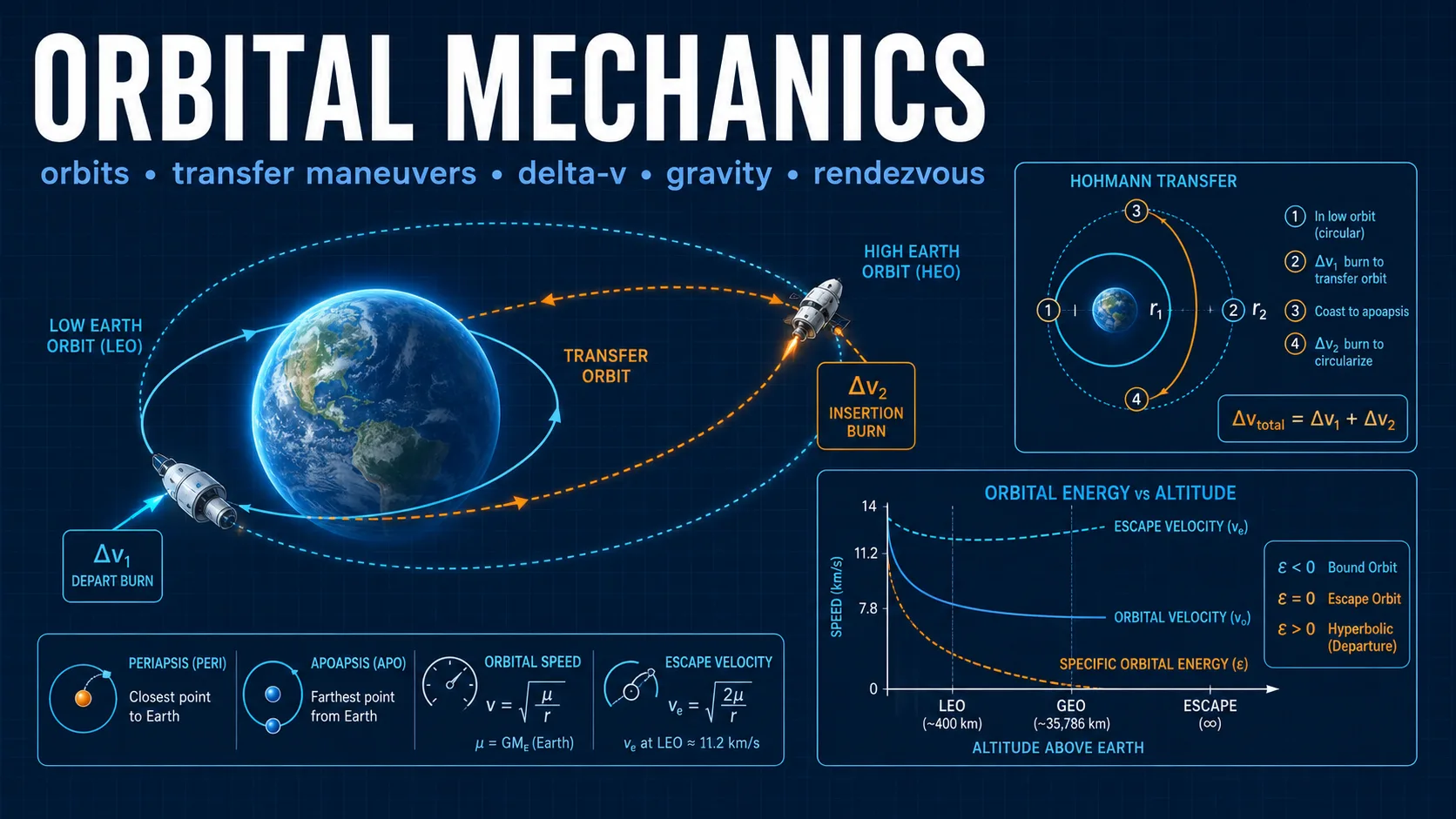
Explore circular and elliptical orbits, vis-viva, transfer maneuvers, rendezvous, launch windows, escape energy, spheres of influence, J2 precession, and synchronous orbits.
Loading interactive tool…
How this tool works
Fourteen guided modules connect orbital geometry, local speed, impulsive maneuvers, planetary alignment, and perturbations.
The workbench covers circular and elliptical orbits, Hohmann and bi-elliptic transfers, plane changes, phasing, patched conics, escape energy, spheres of influence, J2 precession, and synchronous altitude.
Every quantitative graph includes explicit axis units, and all numeric inputs are clamped before calculation and rendering.
Core equations
v = √(μ/r)T = 2π√(a³/μ)v² = μ(2/r − 1/a)Δv_plane = 2v sin(Δi/2)C3 = v∞²r_SOI = a(m/M)²⁄⁵Ω̇ = −(3/2)J₂n(R/p)²cos iAssumptions
- Most modules use ideal two-body point-mass gravity and impulsive maneuvers.
- Circular and Hohmann interplanetary models use coplanar circular planetary orbits.
- Patched-conic calculations join heliocentric and planet-centered solutions at idealized boundaries.
- J2 calculations include only first-order secular oblateness effects.
- Planetary constants are fixed educational reference values rather than time-dependent ephemerides.
Limitations
- The workbench is educational and is not a mission-navigation, conjunction-assessment, launch-window certification, or flight-dynamics operations tool.
- It does not solve Lambert boundary-value problems, model finite burns, atmospheric drag, third-body perturbations, solar radiation pressure, low-thrust spirals, or real ephemerides.
- Operational trajectory design requires validated ephemerides, numerical propagation, uncertainty analysis, maneuver execution models, and independent review.
References and verification
- NASA Glenn and NASA Space MathEducational references for orbital speed, period, escape velocity, and transfer concepts.
- Bate, Mueller, and White, Fundamentals of AstrodynamicsStandard two-body orbital mechanics and impulsive transfer equations.
- Vallado, Fundamentals of Astrodynamics and ApplicationsOrbital elements, perturbations, and mission-analysis terminology.