Loading tool…
Loading interactive tool…

How this tool works

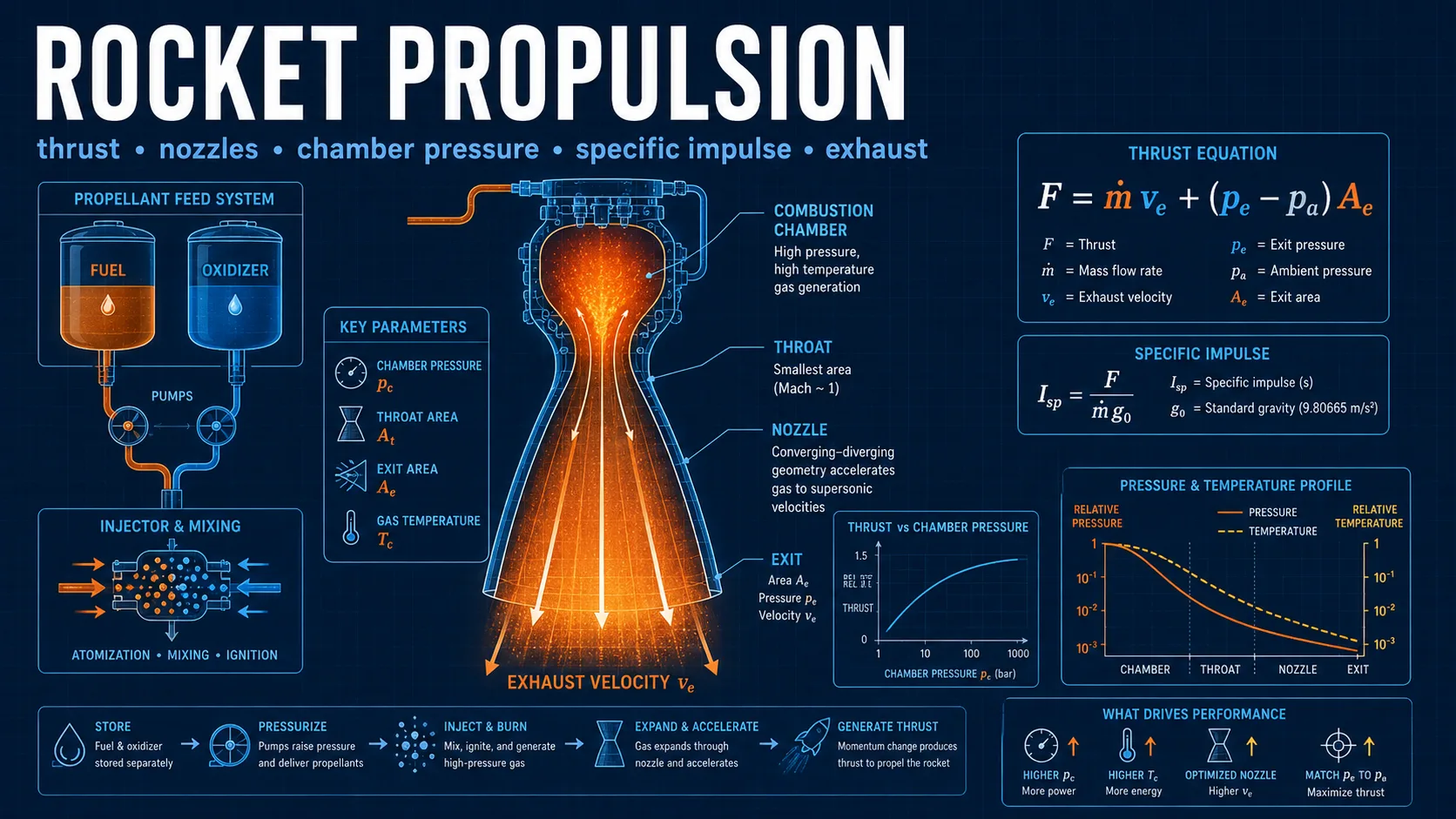
A guided introduction to rocket propulsion that connects engine measurements to vehicle-level performance.

Twelve modules cover thrust, propellant efficiency, mass ratio, nozzles, altitude, staging, feed power, and duty-cycle integration.

Every quantitative graph includes explicit axis units, and all numeric inputs are clamped before calculations and rendering.

Core equations

F = ṁvₑ + (pₑ − pₐ)AₑIsp = F/(ṁg₀)Δv = g₀Isp ln(m₀/m_f)T/W = F/(mg₀)P_pump = ΔpQ/ηI_total = ∫F(t)dt

Assumptions

  • Thrust and burn-time modules use constant or explicitly defined average operating conditions.
  • Nozzle calculations assume steady, one-dimensional, choked, calorically perfect ideal-gas flow.
  • Altitude performance uses a simplified exponential pressure model rather than a full standard atmosphere.
  • Staging calculations are ideal impulsive delta-v estimates and do not model gravity, drag, steering, or finite-burn trajectory effects.
  • Feed-system power is a hydraulic estimate and does not size turbomachinery or predict cavitation.

Limitations

  • The workbench is educational and is not a flight-certification, engine-design, structural, thermal, combustion-instability, or safety-analysis tool.
  • It does not provide propellant recipes, manufacturing procedures, ignition systems, grain geometry, or hazardous test instructions.
  • Real propulsion systems require validated property data, multidimensional flow analysis, materials limits, cooling design, controls, and test evidence.

References and verification

  • NASA Glenn Research CenterRocket thrust, specific impulse, nozzle flow, and rocket-equation educational references.
  • Sutton and Biblarz, Rocket Propulsion ElementsStandard propulsion-performance terminology and idealized equations.