Polymers & Composites Workbench
Explore molecular weight, glass transition, crosslinking, composite density, stiffness, CTE, and load transfer.
Engineering reference
Polymers & Composites: theory, method, and sources
This materials science workspace publishes 11 governing equations, 6 stated assumptions, 1 documented boundary, and 2 sources so the numbers it returns can be checked rather than taken on trust.
How this tool works
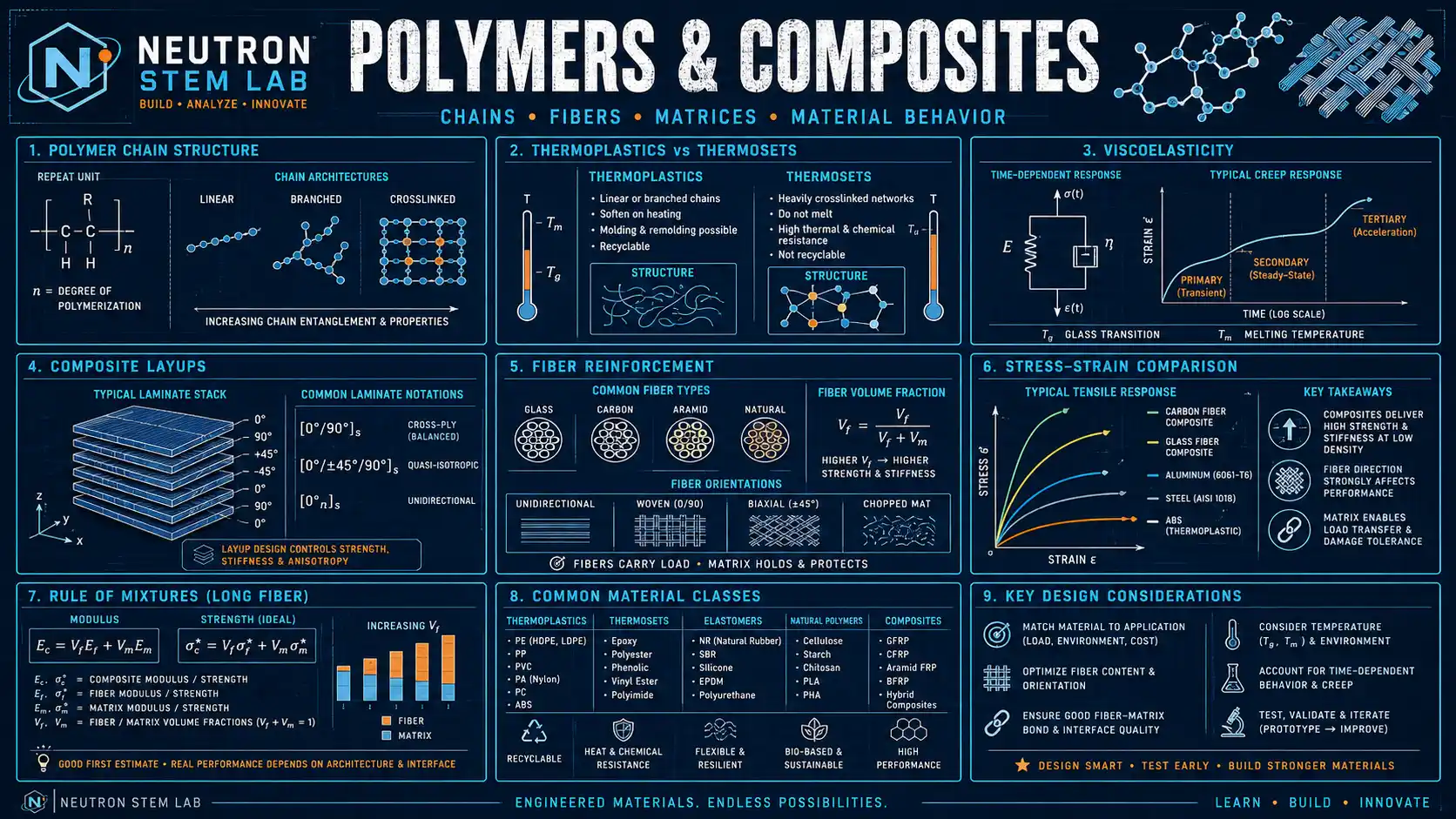
Ten modules cover number and weight average molecular weight, degree of polymerization, the Fox equation for copolymer glass transition, rubber crosslink density, longitudinal and transverse composite modulus, composite density and fibre mass fraction, thermal expansion, the Halpin–Tsai model, and critical fibre length.
Longitudinal and transverse modulus are calculated from the same fibre volume fraction, which shows directly how large the anisotropy of a unidirectional laminate is.
Calculators and topics covered
- polymers
- composites
- fiber reinforcement
- glass transition
- molecular weight
- Fox equation
- rule of mixtures
- Halpin Tsai
- critical fiber length
Core equations
Method and assumptions
Assumptions
- Composites are treated as unidirectional with perfectly aligned, uniformly distributed continuous fibres.
- The fibre–matrix interface is assumed perfect, with no debonding or void content.
- The rule of mixtures gives an upper bound longitudinally and the inverse rule a lower bound transversely; real laminates fall between them.
- The Fox equation assumes fully miscible components with no phase separation.
- Viscoelastic behaviour, moisture absorption, and time- or temperature-dependent creep are not modelled.
- Halpin–Tsai results depend strongly on the reinforcement geometry factor ξ, which must be chosen to match the fibre form.
Limitations and design boundaries
- Educational screening models only. Material certification, process qualification, applicable standards, statistical variability, environmental conditioning, and professional engineering judgment are required for real selection or design.
Sources and references
Primary sources are preferred for ratings, standards, manufacturer data, and externally defined constants.
- Callister and Rethwisch, Materials Science and Engineering: An Introduction
- Askeland and Wright, The Science and Engineering of Materials