Corrosion & Degradation Workbench
Explore electrochemical corrosion, oxidation, coating life, accelerated aging, fatigue damage, and environmental cracking.
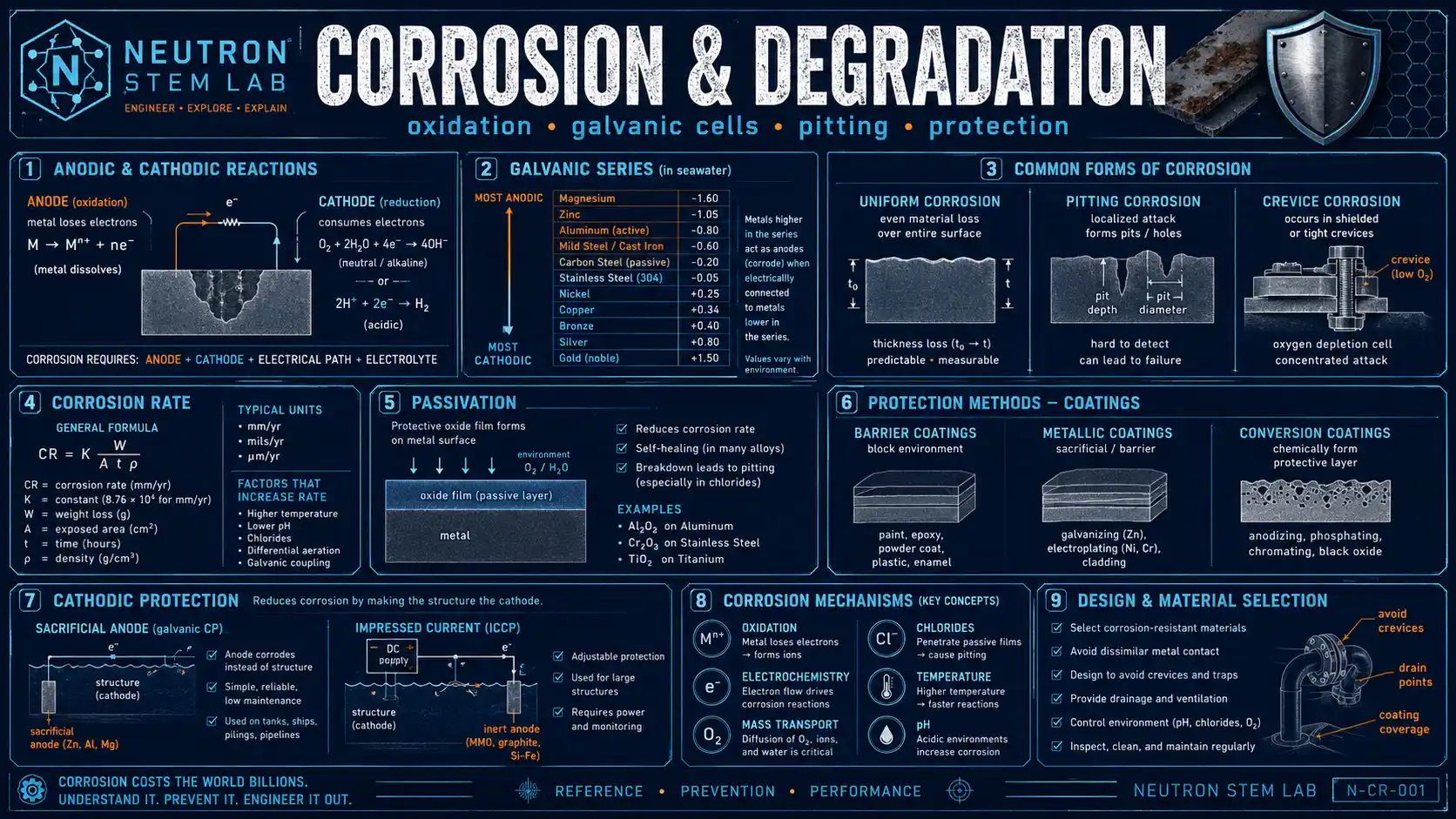
Engineering reference
Corrosion & Degradation: theory, method, and sources
This materials science workspace publishes 10 governing equations, 5 stated assumptions, 1 documented boundary, and 2 sources so the numbers it returns can be checked rather than taken on trust.
How this tool works
Ten modules cover Faraday mass loss, penetration rate, galvanic driving force, the Nernst equation, Tafel kinetics, parabolic oxidation, coating life, Arrhenius test acceleration, Miner’s cumulative damage, and stress corrosion cracking margin.
Electrochemical rate, physical penetration, and remaining service life are linked, so a measured corrosion current density can be carried through to a thickness loss and a coating replacement interval.
Calculators and topics covered
- corrosion
- oxidation
- aging
- coatings
- fatigue damage
- Faraday law
- Nernst equation
- Tafel
- Miner rule
- stress corrosion
Core equations
Method and assumptions
Assumptions
- Uniform corrosion is assumed; pitting, crevice, and intergranular attack are localized and not captured by an average rate.
- Corrosion current density is taken as constant over time, whereas real rates change as films and products build up.
- Parabolic oxidation applies only to diffusion-controlled protective scale growth, not to breakaway or spalling oxidation.
- Arrhenius acceleration assumes the same degradation mechanism operates at both test and service temperature.
- Miner’s rule assumes linear damage accumulation and ignores load sequence effects.
Limitations and design boundaries
- Educational screening models only. Material certification, process qualification, applicable standards, statistical variability, environmental conditioning, and professional engineering judgment are required for real selection or design.
Sources and references
Primary sources are preferred for ratings, standards, manufacturer data, and externally defined constants.
- Callister and Rethwisch, Materials Science and Engineering: An Introduction
- Askeland and Wright, The Science and Engineering of Materials