Materials Reference Center
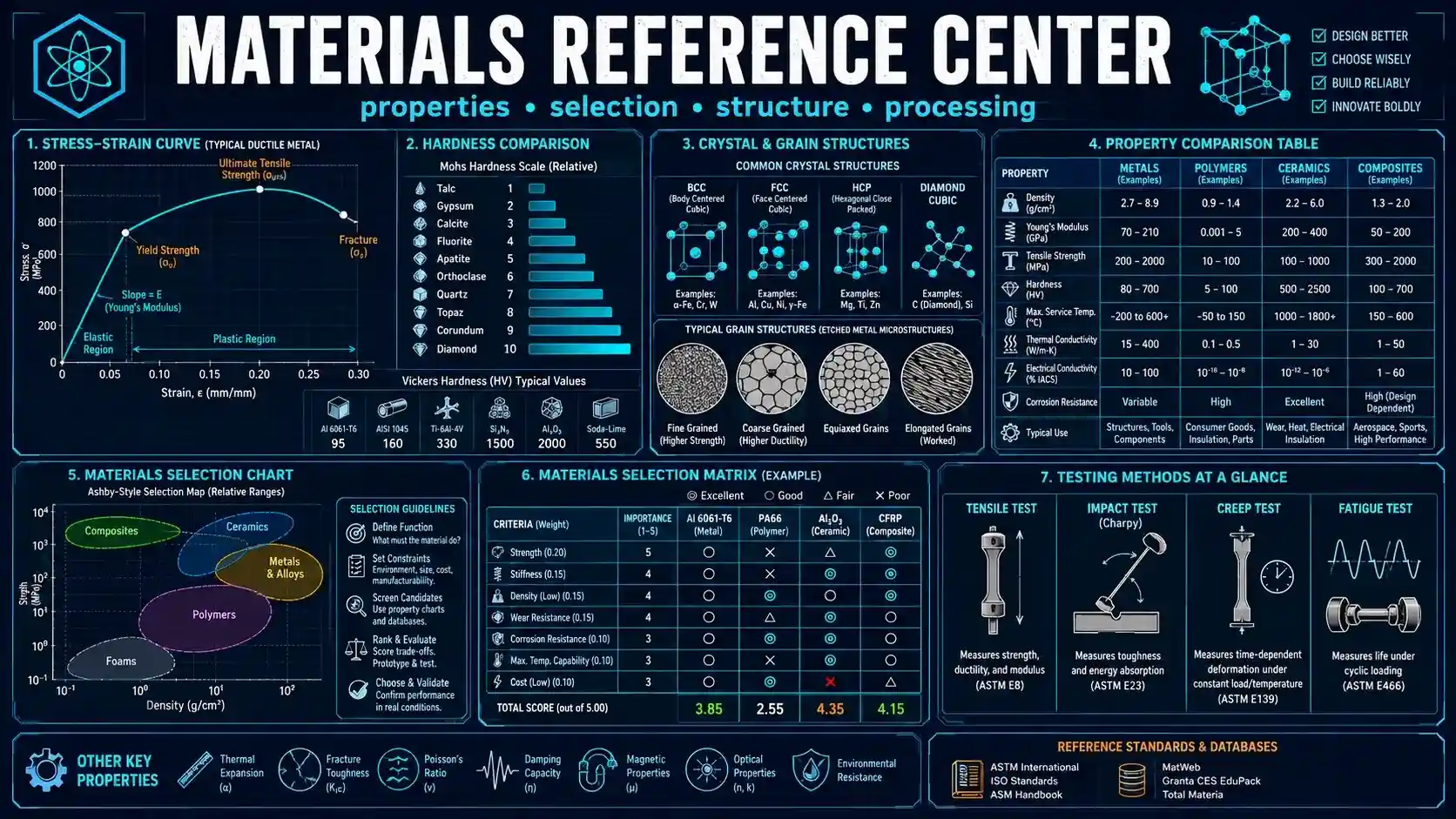
Search detailed material classes, crystal structures, defects, processing, testing, failure modes, and units.
Engineering reference
Materials Reference: theory, method, and sources
This materials science workspace publishes 5 governing equations, 4 stated assumptions, 1 documented boundary, and 2 sources so the numbers it returns can be checked rather than taken on trust.
How this tool works
A browsable reference organized into seven areas: crystal structures, defects and diffusion, failure modes, material classes, processing, testing and characterization, and units and selection.
Each entry lists the governing parameters, selection guidance, and the limitations that apply, so a property range can be judged against the processing history and test method behind it.
Calculators and topics covered
- materials reference
- properties
- processing
- testing
- selection
- metals
- ceramics
- polymers
- crystal structures
- failure modes
Core equations
Method and assumptions
Assumptions
- Property values are representative published ranges and depend strongly on composition, processing, and heat treatment.
- Mechanical properties assume standard specimen geometry and test rate; behaviour differs in thin sections and at service strain rates.
- Entries do not reflect any single material standard or grade specification and should not be used for procurement.
- Environmental effects such as temperature, corrosion, and irradiation are noted qualitatively rather than quantified.
Limitations and design boundaries
- Educational screening models only. Material certification, process qualification, applicable standards, statistical variability, environmental conditioning, and professional engineering judgment are required for real selection or design.
Sources and references
Primary sources are preferred for ratings, standards, manufacturer data, and externally defined constants.
- Callister and Rethwisch, Materials Science and Engineering: An Introduction
- ASM Handbook series