Phase Diagrams & Heat Treatment Workbench
Explore phase fractions, transformations, grain growth, case depth, tempering, and hardenability.
Engineering reference
Phase Diagrams & Heat Treatment: theory, method, and sources
This materials science workspace publishes 9 governing equations, 6 stated assumptions, 1 documented boundary, and 2 sources so the numbers it returns can be checked rather than taken on trust.
How this tool works
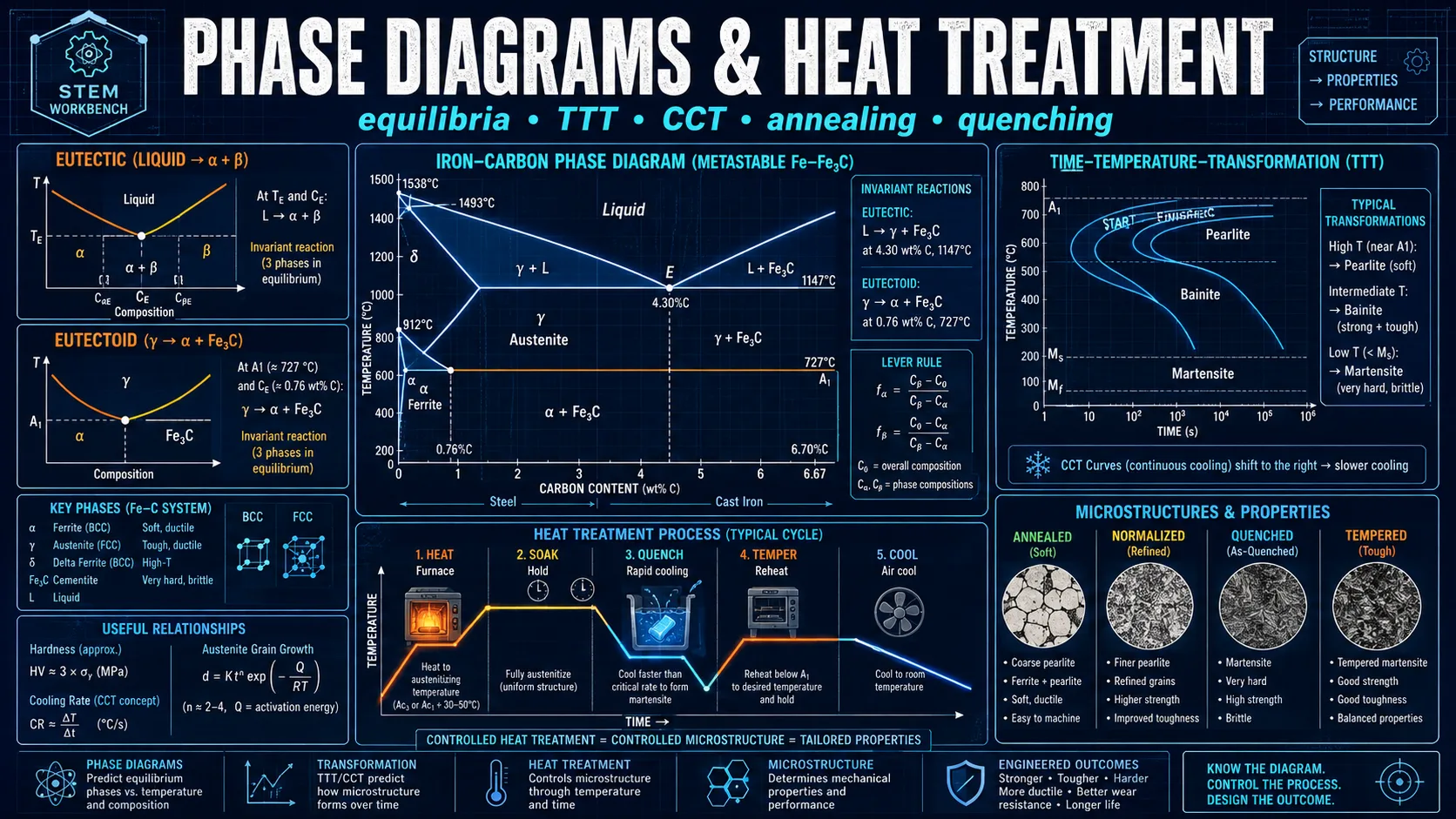
Eleven modules cover the lever rule, eutectic phase fractions, carbon steel equilibrium phases, Avrami transformation kinetics, Arrhenius time–temperature equivalence, grain growth, the Hollomon–Jaffe tempering parameter, cooling rate, carburizing case depth, Jominy hardenability, and sigmoidal phase fraction.
Equilibrium phase fractions and time-dependent transformation kinetics sit side by side, which makes the gap between what a phase diagram predicts and what a real cooling rate produces explicit.
Calculators and topics covered
- phase diagrams
- heat treatment
- steel
- grain growth
- kinetics
- lever rule
- Avrami
- Hollomon Jaffe
- Jominy
- eutectic
Core equations
Method and assumptions
Assumptions
- The lever rule assumes equilibrium at the stated temperature, which real cooling rates rarely achieve.
- Carbon steel fractions use the simplified Fe–Fe₃C diagram with a 0.76 wt% eutectoid and 6.7 wt% cementite.
- Avrami kinetics assume isothermal transformation with constant n and k.
- Grain growth and case depth use single-mechanism power law and parabolic forms respectively.
- The Jominy model is an exponential fit for teaching the shape of a hardenability curve, not a substitute for measured Jominy data.
- Alloying element effects on transformation temperatures and hardenability are not modelled.
Limitations and design boundaries
- Educational screening models only. Material certification, process qualification, applicable standards, statistical variability, environmental conditioning, and professional engineering judgment are required for real selection or design.
Sources and references
Primary sources are preferred for ratings, standards, manufacturer data, and externally defined constants.
- Callister and Rethwisch, Materials Science and Engineering: An Introduction
- Askeland and Wright, The Science and Engineering of Materials