Functional Materials Workbench
Explore thermal, electrical, dielectric, magnetic, thermoelectric, and optical material properties.
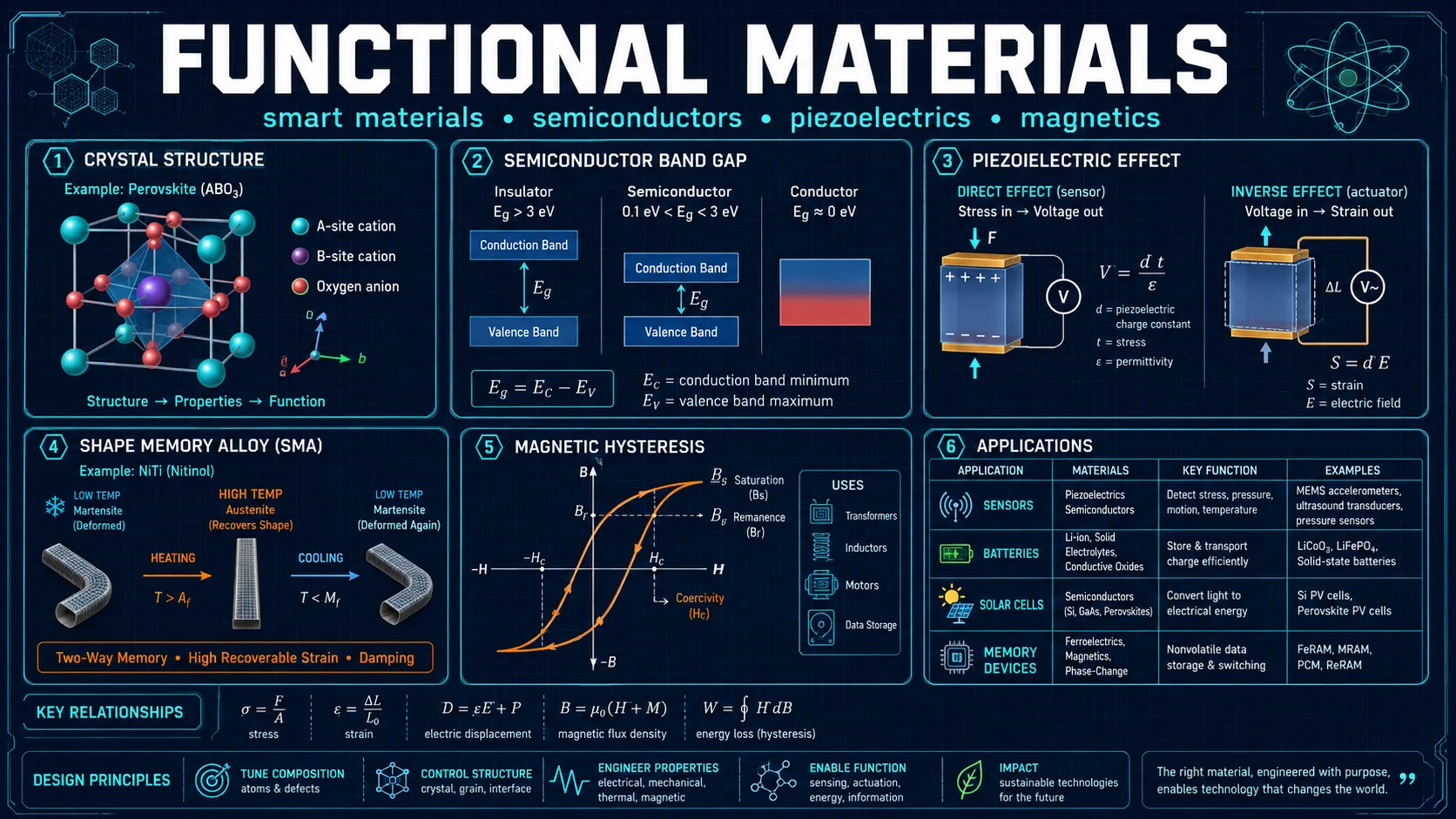
Engineering reference
Functional Materials: theory, method, and sources
This materials science workspace publishes 13 governing equations, 5 stated assumptions, 1 documented boundary, and 2 sources so the numbers it returns can be checked rather than taken on trust.
How this tool works
Thirteen modules cover thermal conduction and layered resistance, thermal expansion, electrical resistance and its temperature dependence, the Wiedemann–Franz relationship, Seebeck voltage, dielectric capacitance and loss, magnetic response, Curie–Weiss susceptibility, Beer–Lambert absorption, and bandgap wavelength.
The thermal, electrical, dielectric, magnetic, and optical property groups use a consistent SI basis, so the same material can be characterized across several functional behaviours in one session.
Calculators and topics covered
- thermal properties
- electrical properties
- dielectrics
- magnetism
- optical materials
- thermal conductivity
- resistivity
- Seebeck
- permittivity
- bandgap
Core equations
Method and assumptions
Assumptions
- Properties are treated as isotropic and independent of temperature except where a module explicitly models the temperature dependence.
- Thermal conduction is one-dimensional and steady state, with perfect contact between layers and no interfacial resistance.
- The resistivity temperature coefficient is linear, which holds only over a moderate range around the reference temperature.
- The Wiedemann–Franz relationship assumes electronic conduction dominates and breaks down where phonon transport is significant.
- Dielectric loss uses a single loss tangent at the stated frequency; dispersion is not modelled.
Limitations and design boundaries
- Educational screening models only. Material certification, process qualification, applicable standards, statistical variability, environmental conditioning, and professional engineering judgment are required for real selection or design.
Sources and references
Primary sources are preferred for ratings, standards, manufacturer data, and externally defined constants.
- Callister and Rethwisch, Materials Science and Engineering: An Introduction
- Askeland and Wright, The Science and Engineering of Materials