Mechanical Properties & Failure Workbench
Reduce mechanical-test data and explore elasticity, hardness, fatigue, creep, fracture, and strengthening.
Engineering reference
Mechanical Properties & Failure: theory, method, and sources
This materials science workspace publishes 12 governing equations, 6 stated assumptions, 1 documented boundary, and 2 sources so the numbers it returns can be checked rather than taken on trust.
How this tool works
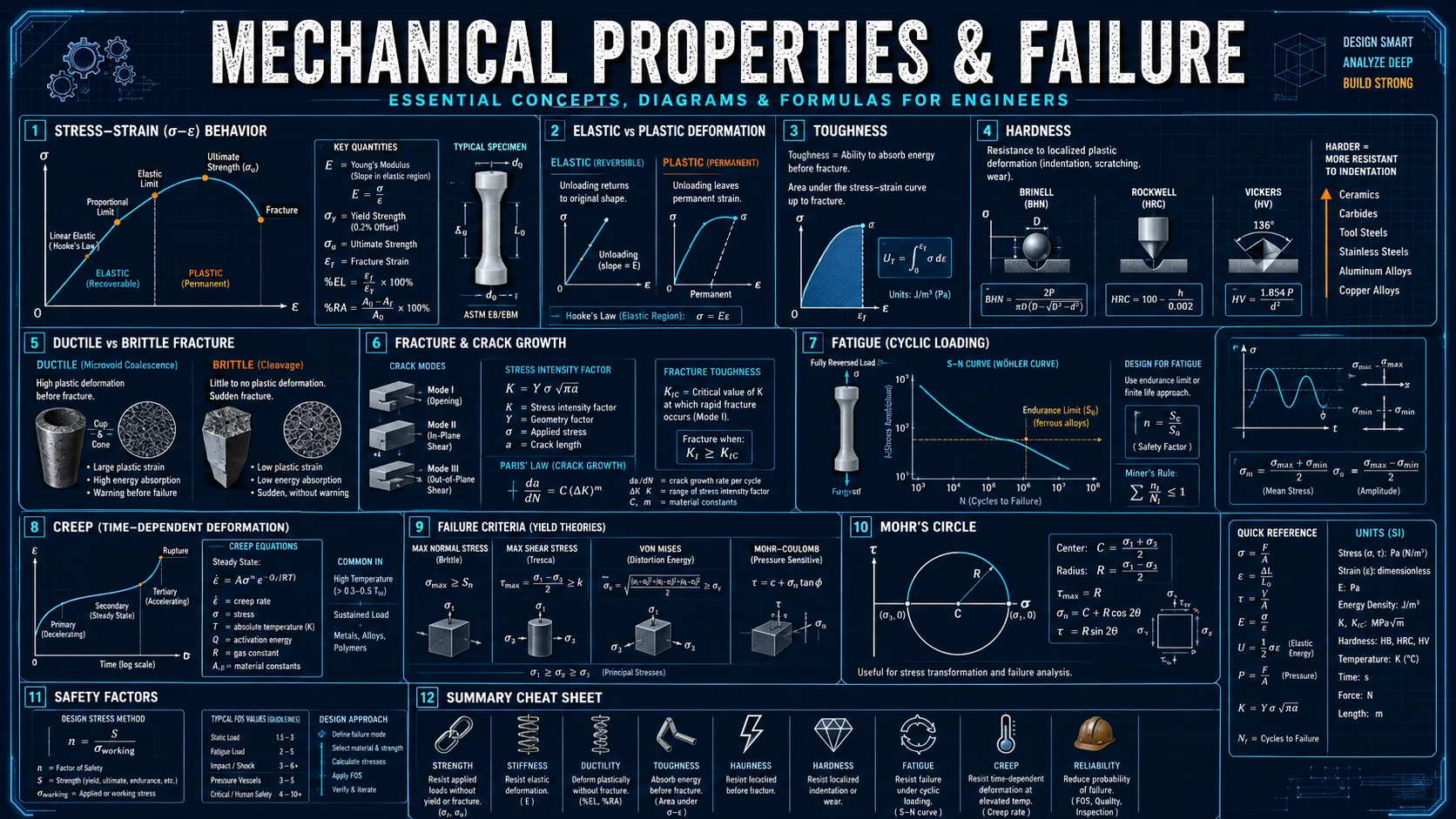
Eleven modules cover engineering and true stress–strain, isotropic elastic constants, modulus of resilience, toughness by curve integration, Vickers hardness, Charpy impact energy, critical crack stress, Paris law fatigue crack growth, Basquin high-cycle fatigue, Norton creep, and Hall–Petch strengthening.
Fracture, fatigue, and creep are treated with the same stress basis, so a design stress can be checked against fast fracture, cyclic life, and time-dependent deformation in sequence.
Calculators and topics covered
- stress strain
- fracture
- fatigue
- creep
- hardness
- tensile test
- Vickers
- Hall Petch
- Basquin
- fracture toughness
Core equations
Method and assumptions
Assumptions
- Materials are homogeneous, isotropic, and free of residual stress unless stated.
- Engineering stress uses the original cross-sectional area, so it diverges from true stress after necking begins.
- Linear elastic fracture mechanics applies, which requires small-scale yielding at the crack tip.
- Paris law integration assumes constant amplitude loading with no crack closure, overload retardation, or threshold effects.
- Basquin and Norton coefficients are material- and temperature-specific and must come from test data for the exact condition.
- Fatigue and creep predictions are order-of-magnitude estimates, not certified life.
Limitations and design boundaries
- Educational screening models only. Material certification, process qualification, applicable standards, statistical variability, environmental conditioning, and professional engineering judgment are required for real selection or design.
Sources and references
Primary sources are preferred for ratings, standards, manufacturer data, and externally defined constants.
- Callister and Rethwisch, Materials Science and Engineering: An Introduction
- Askeland and Wright, The Science and Engineering of Materials