Browser-local interactive workspace
Interactive workspace initializes in your browser. Engineering method, assumptions, validation, and references are available below.

Engineering reference

Compressible Flow: theory, method, and sources

This fluid mechanics workspace publishes 10 governing equations, 5 stated assumptions, 1 documented boundary, and 2 sources so the numbers it returns can be checked rather than taken on trust.

Calculations run locallyCalculation & source methodology

How this tool works

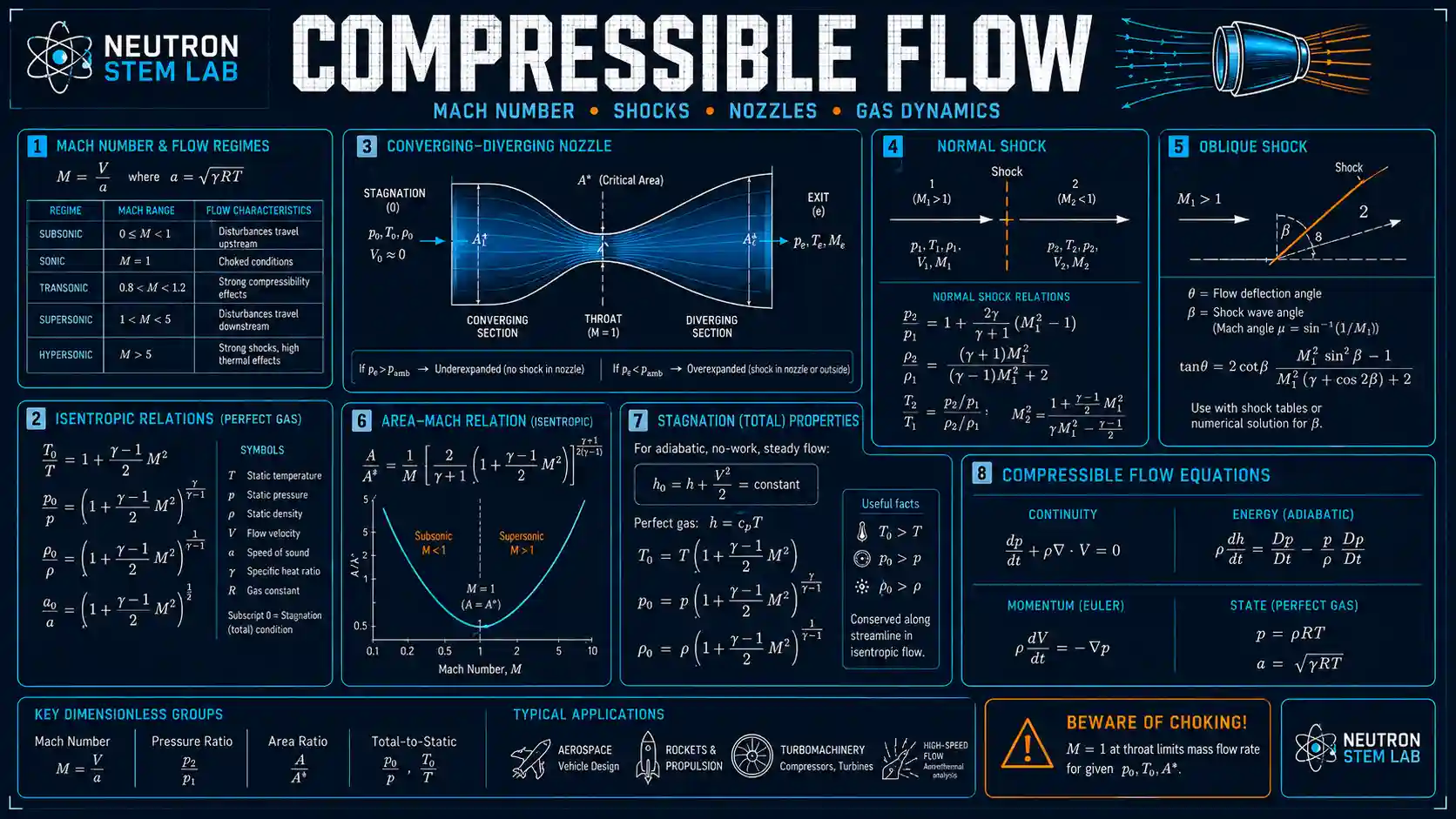
Nine modules cover the compressible flow chain: speed of sound and Mach number, stagnation properties, isentropic ratios, area–Mach relations, choked mass flow, normal shocks, Prandtl–Meyer expansion, mass flux, and nozzle thrust.

The area–Mach solver returns both the subsonic and supersonic branch, which is the ambiguity students most often miss when sizing a converging–diverging nozzle.

Calculators and topics covered

  • Mach number
  • nozzles
  • shocks
  • choked flow
  • stagnation pressure
  • area-Mach relation
  • normal shock
  • Prandtl-Meyer
  • mass flux

Core equations

speed of sound:a=γRT\text{speed of sound:}\quad a = \sqrt{\gamma RT}Mach number:M=Va\text{Mach number:}\quad M = \frac{V}{a}stagnation temperature:T0T=1+(γ1)M22\text{stagnation temperature:}\quad \frac{T_{0}}{T} = 1 \frac{+ \left(\gamma - 1\right) M^{2}}{2}stagnation pressure:p0p=[1+(γ1)M22]γγ1\text{stagnation pressure:}\quad \frac{p_{0}}{p} = \left[1 \frac{+ \left(\gamma - 1\right) M^{2}}{2}\right]^{\frac{\gamma }{\gamma - 1}}area ratio:AA=(1M)[(2γ+1)(1+(γ1)M22)]γ+12(γ1)\text{area ratio:}\quad \frac{A}{A^{*}} = \left(\frac{1}{M}\right) \left[\left(\frac{2}{\gamma + 1}\right) \left(1 \frac{+ \left(\gamma - 1\right) M^{2}}{2}\right)\right]^{\frac{\gamma + 1}{2 \left(\gamma - 1\right)}}choked mass flow:m˙=Cd  A  p0γRT0[2γ+1]γ+12(γ1)\text{choked mass flow:}\quad \dot{m} = C_{d}\; A\; p_{0} \sqrt{\frac{\gamma }{RT_{0}}} \cdot \left[\frac{2}{\gamma + 1}\right]^{\frac{\gamma + 1}{2 \left(\gamma - 1\right)}}normal shock:M22=1+(γ1)M122γM12(γ1)2\text{normal shock:}\quad M_{2}^{2} = \frac{1 \frac{+ \left(\gamma - 1\right) M_{1}^{2}}{2}}{\gamma M_{1}^{2} \frac{- \left(\gamma - 1\right)}{2}}shock pressure ratio:p2p1=1+2γ(M121)γ+1\text{shock pressure ratio:}\quad \frac{p_{2}}{p_{1}} = 1 \frac{+ 2 \gamma \left(M_{1}^{2} - 1\right)}{\gamma + 1}Prandtl–Meyer:ν(M)=γ+1γ1atan(γ1)(M21)γ+1atanM21\text{Prandtl–Meyer:}\quad \nu \left(M\right) = \sqrt{\frac{\gamma + 1}{\gamma - 1}} \cdot atan \sqrt{\frac{\left(\gamma - 1\right) \left(M^{2} - 1\right)}{\gamma + 1}} - atan \sqrt{M^{2} - 1}nozzle thrust:F=m˙ve+(pepa)Ae\text{nozzle thrust:}\quad F = \dot{m} v_{e} + \left(p_{e} - p_{a}\right) A_{e}

Method and assumptions

Assumptions

  • The working fluid is a calorically perfect ideal gas with constant specific heat ratio γ.
  • Flow is steady, one-dimensional, and adiabatic; isentropic relations additionally assume no friction.
  • Normal shock relations apply to a stationary, planar shock in a uniform stream.
  • Prandtl–Meyer expansion assumes two-dimensional, isentropic turning of supersonic flow.
  • Boundary layers, heat transfer, real gas effects, and dissociation at high temperature are not modelled.

Limitations and design boundaries

  • Educational screening calculations only. Real systems require verified fluid properties, calibrated coefficients, uncertainty analysis, applicable codes and standards, and qualified engineering review.

Sources and references

Primary sources are preferred for ratings, standards, manufacturer data, and externally defined constants.

Source policy
  • Çengel and Cimbala, Fluid Mechanics: Fundamentals and Applications
  • Munson et al., Fundamentals of Fluid Mechanics