Fluid Properties & Hydrostatics Workbench
Calculate density, pressure, hydrostatic forces, buoyancy, floating stability, capillarity, compressibility, and viscous shear.
Engineering reference
Fluid Properties & Hydrostatics: theory, method, and sources
This fluid mechanics workspace publishes 10 governing equations, 5 stated assumptions, 1 documented boundary, and 2 sources so the numbers it returns can be checked rather than taken on trust.
How this tool works
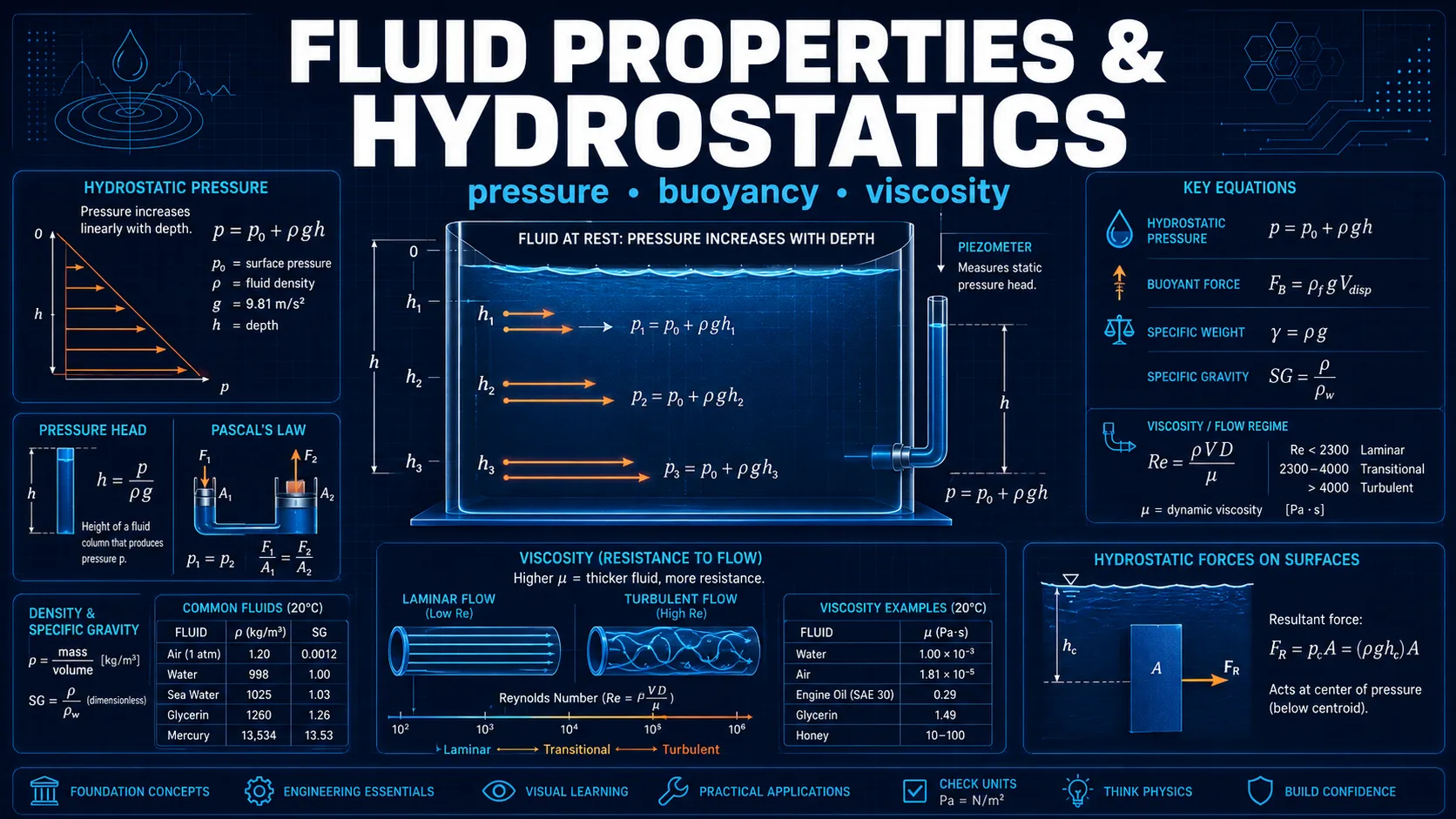
Ten modules cover density and specific weight, hydrostatic pressure, manometry, hydrostatic force on submerged surfaces, buoyancy, barge stability, capillary rise, bulk compressibility, Couette flow, and viscosity relationships.
The stability module computes the metacentric height from the barge geometry, which determines whether a floating body returns upright after a small heel rather than capsizing.
Calculators and topics covered
- density
- pressure
- buoyancy
- viscosity
- hydrostatic pressure
- manometer
- center of pressure
- metacentric height
- capillary rise
Core equations
Method and assumptions
Assumptions
- The fluid is at rest and incompressible for all hydrostatic modules, with constant density through the depth.
- Gauge pressure is measured relative to a user-supplied surface pressure, taken as atmospheric by default.
- Barge stability uses a rectangular waterplane and assumes small heel angles, so the metacentre is treated as fixed.
- Capillary rise assumes a clean circular tube and a uniform contact angle.
- Couette flow assumes a linear velocity profile between parallel plates in the laminar regime.
Limitations and design boundaries
- Educational screening calculations only. Real systems require verified fluid properties, calibrated coefficients, uncertainty analysis, applicable codes and standards, and qualified engineering review.
Sources and references
Primary sources are preferred for ratings, standards, manufacturer data, and externally defined constants.
- Çengel and Cimbala, Fluid Mechanics: Fundamentals and Applications
- Munson et al., Fundamentals of Fluid Mechanics