Fluid Machinery & Hydraulic Systems Workbench
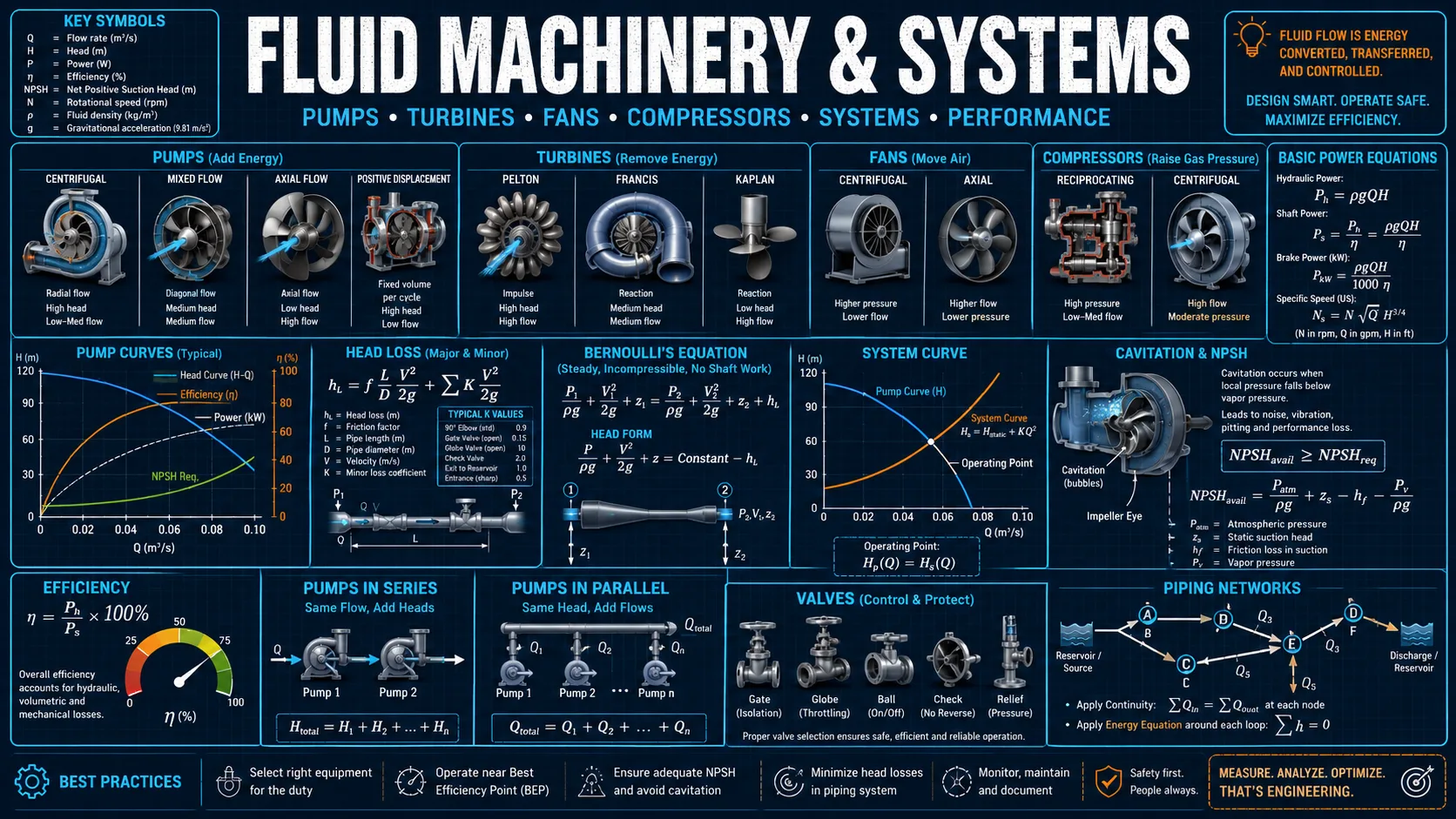
Analyze pumps, turbines, operating points, affinity laws, NPSH, pump combinations, cylinders, accumulators, and fans.
Engineering reference
Fluid Machinery & Systems: theory, method, and sources
This fluid mechanics workspace publishes 10 governing equations, 5 stated assumptions, 1 documented boundary, and 2 sources so the numbers it returns can be checked rather than taken on trust.
How this tool works
Ten modules cover pump and turbine power, system and pump curve intersection, affinity laws, net positive suction head, specific speed, series and parallel pump combinations, hydraulic cylinders, accumulators, and fan laws.
The operating point module solves the intersection of a quadratic pump curve with a system curve, which is the calculation that determines the flow a given pump will actually deliver rather than its rated flow.
Calculators and topics covered
- pumps
- turbines
- hydraulics
- fans
- NPSH
- pump curve
- system curve
- affinity laws
- hydraulic cylinder
Core equations
Method and assumptions
Assumptions
- Pump and system curves are represented by simple quadratic forms rather than manufacturer-tabulated data.
- Efficiency is a single constant value and does not vary with flow across the operating range.
- Affinity laws assume geometric similarity and constant efficiency, which holds only over a limited speed range.
- NPSH available is compared to a required value that must come from the pump manufacturer; cavitation margin is not assumed.
- Series and parallel combinations assume identical pumps and neglect interaction losses in the manifold.
Limitations and design boundaries
- Educational screening calculations only. Real systems require verified fluid properties, calibrated coefficients, uncertainty analysis, applicable codes and standards, and qualified engineering review.
Sources and references
Primary sources are preferred for ratings, standards, manufacturer data, and externally defined constants.
- Çengel and Cimbala, Fluid Mechanics: Fundamentals and Applications
- Munson et al., Fundamentals of Fluid Mechanics