Fluid Mechanics Reference Center
Browse detailed fluid properties, dimensionless numbers, equations, devices, measurement methods, modeling guidance, and limitations.
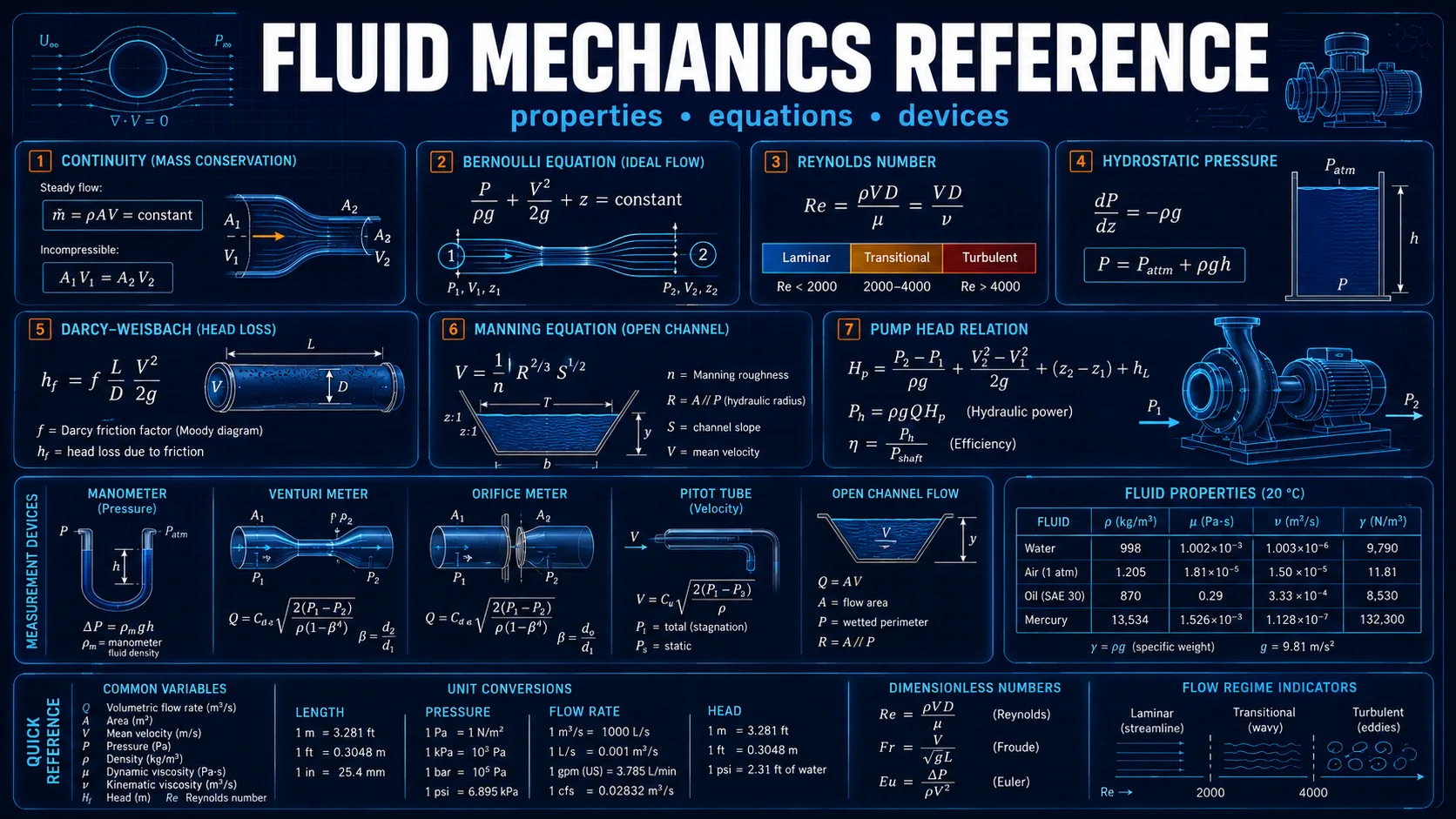
Engineering reference
Fluid Mechanics Reference: theory, method, and sources
This fluid mechanics workspace publishes 7 governing equations, 4 stated assumptions, 1 documented boundary, and 2 sources so the numbers it returns can be checked rather than taken on trust.
How this tool works
A browsable reference organized into six areas: fluid properties, dimensionless numbers, core equations, flow devices, measurement, and modeling and safety.
Each entry states what the relationship is used for, the range over which it is valid, and the conditions that invalidate it, so the correlation can be checked against the situation before it is applied.
Calculators and topics covered
- reference
- properties
- equations
- measurement
- fluid properties
- dimensionless numbers
- flow meters
- CFD
- engineering safety
Core equations
Method and assumptions
Assumptions
- Property values are representative for water and air at standard conditions and vary with temperature and pressure.
- Correlations are empirical and valid only within the Reynolds number and roughness ranges stated in each entry.
- Bernoulli-based entries assume steady, incompressible, inviscid flow along a streamline.
- Discharge coefficients depend on device geometry and approach conditions and should be taken from calibration data where accuracy matters.
Limitations and design boundaries
- Educational screening calculations only. Real systems require verified fluid properties, calibrated coefficients, uncertainty analysis, applicable codes and standards, and qualified engineering review.
Sources and references
Primary sources are preferred for ratings, standards, manufacturer data, and externally defined constants.
- Çengel and Cimbala, Fluid Mechanics: Fundamentals and Applications
- Munson et al., Fundamentals of Fluid Mechanics