Organic Chemistry Workbench
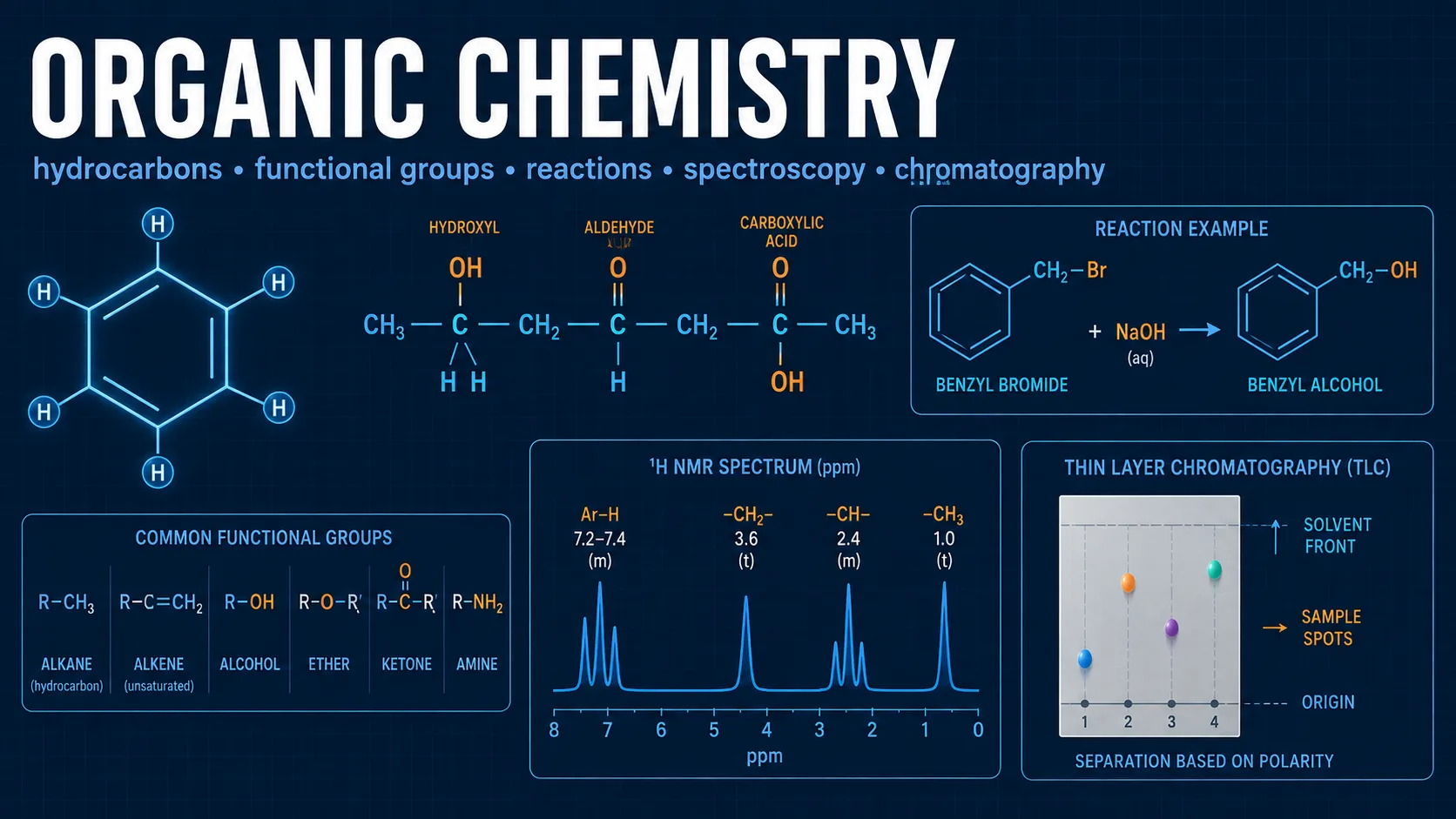
Twelve guided modules for functional groups, nomenclature, molecular formulas, stereochemistry, conformations, acidity, mechanisms, reactions, spectroscopy, aromaticity, polymers, and chromatography.
Engineering reference
Organic Chemistry: theory, method, and sources
This chemistry workspace publishes 6 governing equations, 5 stated assumptions, 3 documented boundaries, and 3 sources so the numbers it returns can be checked rather than taken on trust.
How this tool works
The workbench is organized as a guided learning sequence rather than a disconnected set of calculators.
Every module includes a chemical question, real context, learning objective, observations, a dynamic visual, current-value reasoning, and a practice challenge.
Spectroscopy graphs display explicit units, and all numerical and imported values are bounded before calculation or rendering.
Calculators and topics covered
- organic chemistry
- functional groups
- IUPAC naming
- stereochemistry
- reaction mechanisms
- spectroscopy
- aromaticity
- polymers
- chromatography
- organic chemistry workbench
- functional group identifier
- IUPAC naming practice
- degree of unsaturation calculator
- R S stereochemistry
Core equations
Method and assumptions
Assumptions
- The nomenclature builder covers simple acyclic molecules with one principal functional group and a limited substituent set.
- The butane conformational-energy profile is an educational interpolation through representative anti, gauche, and eclipsed energies.
- Mechanism scores are qualitative comparisons and are not measured product distributions.
- IR and proton-NMR spectra are simplified teaching spectra for selected compounds rather than instrument simulations.
- Polymer models show repeat-unit structure and chain count without predicting dispersity, conversion, or molecular-weight distribution.
Limitations and design boundaries
- The workbench does not replace a complete IUPAC nomenclature engine, spectral database, quantum-chemistry package, or laboratory safety protocol.
- Rearrangements, neighboring-group effects, detailed stereoelectronics, solvent mixtures, and multistep synthesis optimization are outside this version.
- Chemical structures and mechanisms are schematic and intended for instruction.
Sources and references
Primary sources are preferred for ratings, standards, manufacturer data, and externally defined constants.
- Clayden, Greeves and Warren, Organic ChemistryMechanism classes, stereochemistry, and structure-reactivity relationships.
- Vollhardt and Schore, Organic Chemistry: Structure and FunctionFunctional group behaviour and nomenclature conventions.
- McMurry, Organic ChemistryDegrees of unsaturation, substitution and elimination pathways, and spectroscopic correlation.