General Chemistry Workbench
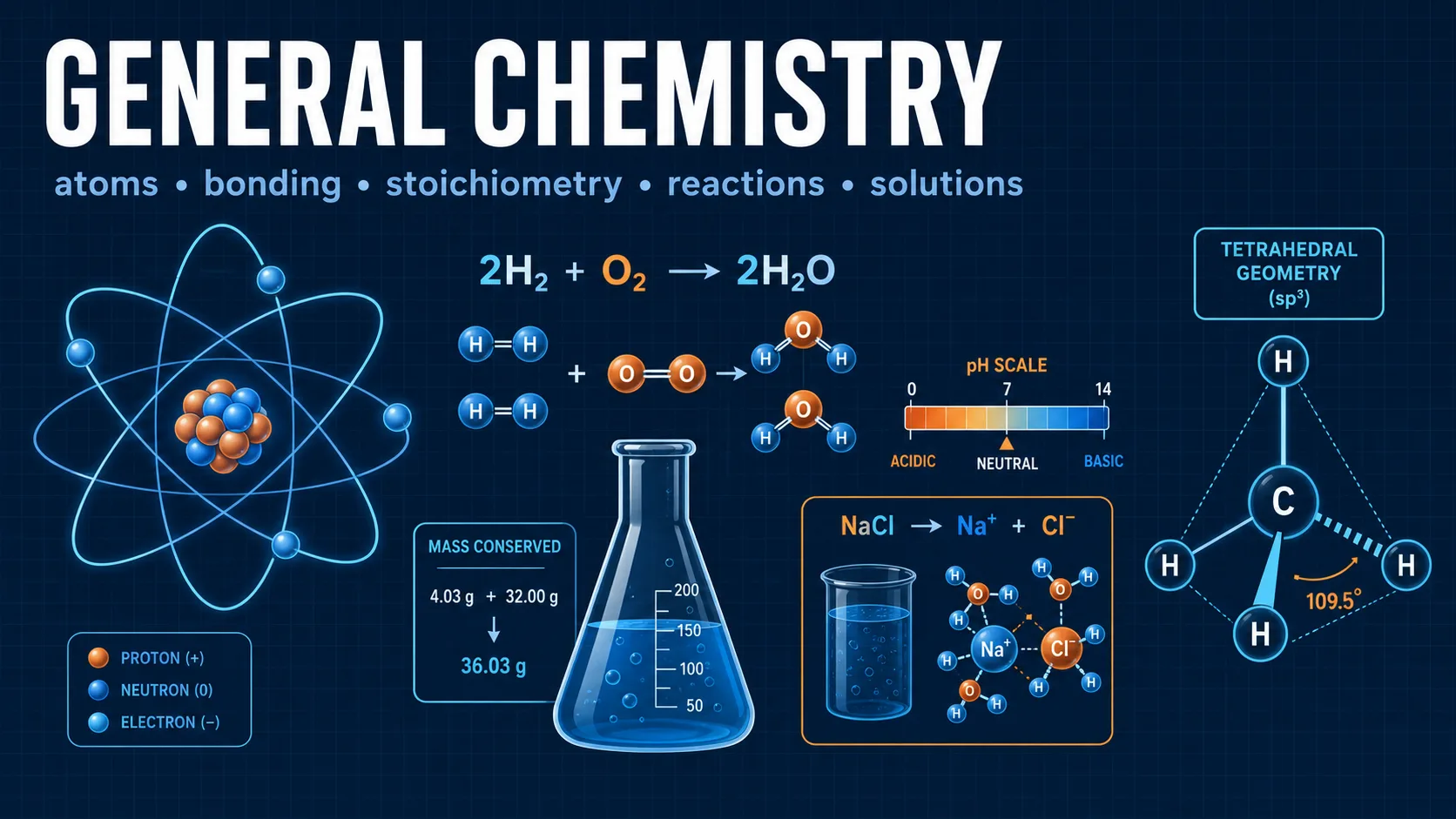
Sixteen calculators and visual models for atoms, formulas, reactions, gases, solutions, acids and bases, equilibrium, energy, kinetics, electronic structure, geometry, and nuclear decay.
Engineering reference
General Chemistry: theory, method, and sources
This chemistry workspace publishes 8 governing equations, 6 stated assumptions, 3 documented boundaries, and 3 sources so the numbers it returns can be checked rather than taken on trust.
How this tool works
The workbench separates sixteen foundational chemistry tasks into focused tabs with live diagrams and graphs.
Formula parsing supports grouped formulas and hydrates, while equation balancing uses exact rational arithmetic.
All numerical inputs, imported state, text size, dataset size, and graph sample counts are bounded before calculation.
Calculators and topics covered
- general chemistry
- stoichiometry
- molar mass
- gas laws
- solutions
- acid base
- equilibrium
- kinetics
- electron configuration
- VSEPR
- molar mass calculator
- chemical equation balancer
- stoichiometry calculator
- limiting reactant calculator
Core equations
Method and assumptions
Assumptions
- Atomic masses are standard representative values suitable for educational calculations.
- The equation balancer handles molecular equations and does not independently conserve ionic charge or electrons.
- Gas-law calculations assume ideal behavior.
- Acid–base and titration models use dilute aqueous solutions at 25 °C with Kw = 1.0×10⁻¹⁴.
- The equilibrium tab models one reaction of the form aA + bB ⇌ cC + dD using concentrations.
- Arrhenius calculations assume the pre-exponential factor and activation energy remain constant over the selected temperatures.
Limitations and design boundaries
- Activities, nonideal gases and solutions, polyprotic acid systems, precipitation, electrochemical half-reactions, and detailed quantum-chemical calculations are outside this version.
- The visualizations are schematic and are not molecular-dynamics simulations.
- Results are educational estimates and are not substitutes for laboratory safety procedures or regulated analytical methods.
Sources and references
Primary sources are preferred for ratings, standards, manufacturer data, and externally defined constants.
- Brown, LeMay, Bursten, Murphy and Woodward, Chemistry: The Central ScienceStoichiometry, gas laws, solution concentration, and reaction energetics.
- Zumdahl and Zumdahl, ChemistryLimiting reagent, percent yield, and empirical formula procedures.
- CODATA Internationally Recommended Values of the Fundamental Physical ConstantsValues used for the gas constant and the Avogadro constant.