Chemistry Reference Center
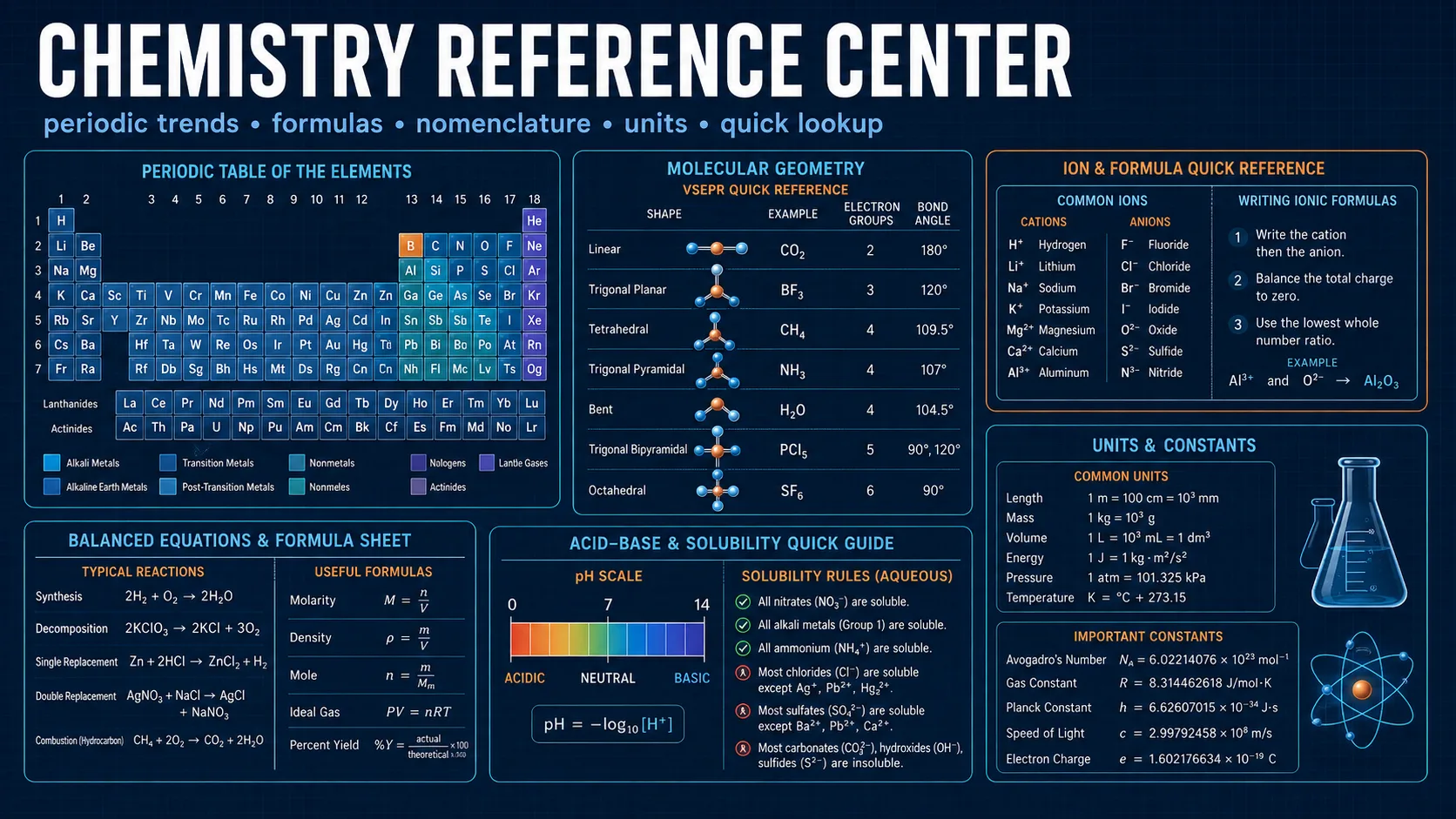
Searchable periodic table and practical references for elements, ions, ionic formulas, solubility rules, acids and bases, activity series, VSEPR shapes, constants, and equations.
Engineering reference
Chemistry Reference: theory, method, and sources
This chemistry workspace publishes 6 governing equations, 4 stated assumptions, 3 documented boundaries, and 3 sources so the numbers it returns can be checked rather than taken on trust.
How this tool works
The reference center turns commonly memorized chemistry tables into searchable, connected tools.
Element selection links periodic position, atomic mass, oxidation states, electronegativity, phase, and electron configuration.
Ion, solubility, acid–base, activity-series, and VSEPR sections explain when and how each reference should be used.
Calculators and topics covered
- periodic table
- chemistry reference
- polyatomic ions
- solubility rules
- strong acids
- activity series
- VSEPR
- chemistry constants
- interactive periodic table
- polyatomic ion chart
- ionic formula builder
- solubility rules checker
- strong acid list
- metal activity series
Core equations
Method and assumptions
Assumptions
- Atomic masses are representative standard values suitable for educational calculations.
- Solubility predictions use common introductory aqueous rules rather than measured Ksp values.
- Electronegativity and oxidation-state entries are a compact reference and are not exhaustive.
- VSEPR diagrams are schematic two-dimensional representations of three-dimensional electron domains.
Limitations and design boundaries
- Room-temperature phase and compact property data do not represent all allotropes, pressures, or metastable forms.
- Activity-series predictions can be altered by passivation, kinetics, concentration, complex formation, and oxidizing conditions.
- Reference values should be checked against an appropriate authoritative source for laboratory, industrial, or regulated work.
Sources and references
Primary sources are preferred for ratings, standards, manufacturer data, and externally defined constants.
- IUPAC Periodic Table of the ElementsElement symbols, atomic numbers, and standard atomic weights.
- CODATA Internationally Recommended Values of the Fundamental Physical ConstantsAvogadro constant, gas constant, and other constants quoted in the reference entries.
- Haynes, CRC Handbook of Chemistry and PhysicsSolubility rules, ion charges, and tabulated physical property ranges.