NASA Glenn Thermochemical Data Explorer
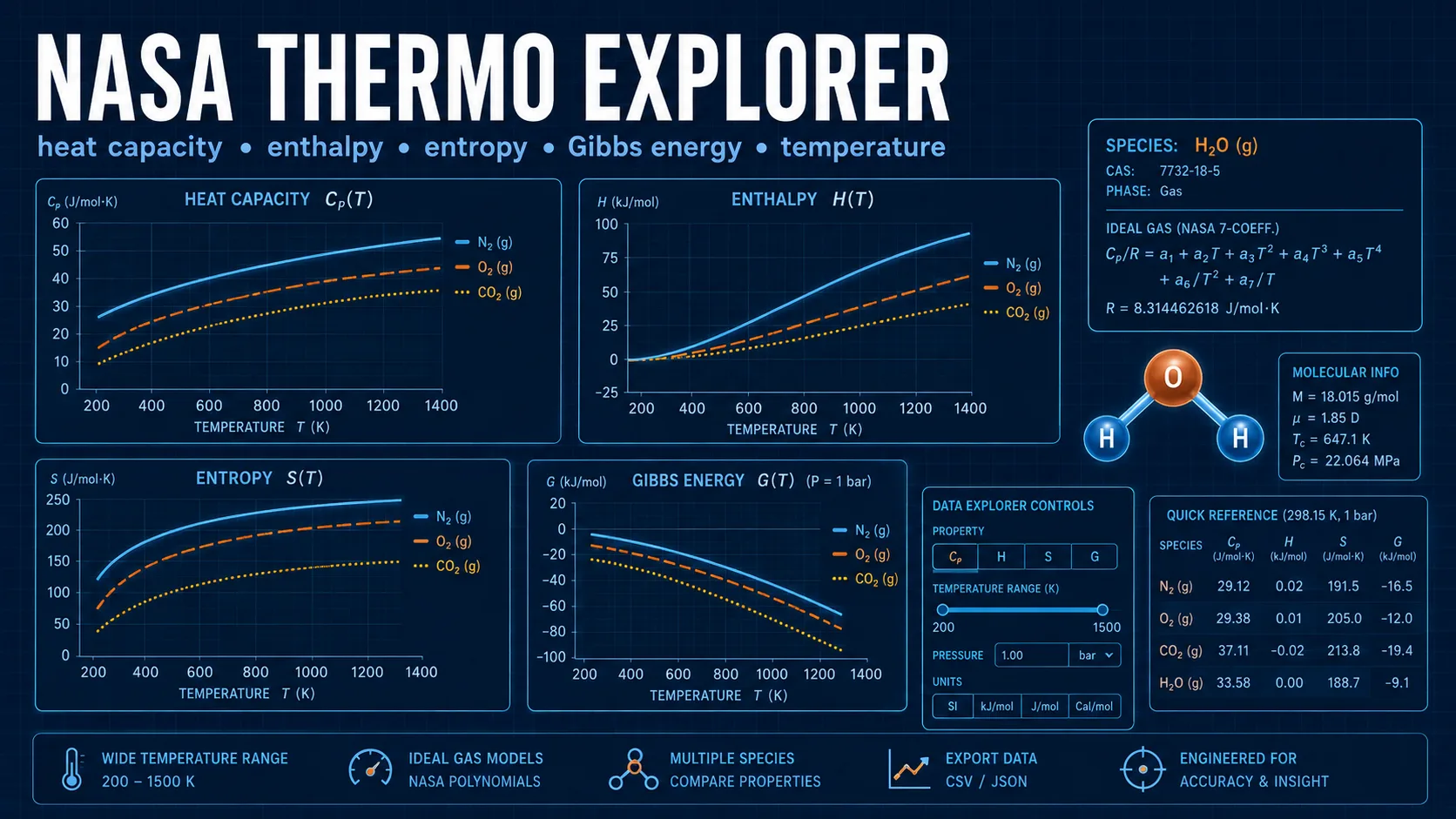
Standard heat capacity, enthalpy, entropy, and Gibbs energy for 49 species from NASA’s published polynomial fits, with reaction properties and equilibrium constants across temperature.
Engineering reference
NASA Thermo Data: theory, method, and sources
This chemistry workspace publishes 4 governing equations, 3 stated assumptions, 4 documented boundaries, and 2 sources so the numbers it returns can be checked rather than taken on trust.
How this tool works
Textbook problems hand you ΔH° and S° at 298 K and stop there. This tool uses NASA’s nine-term polynomial fits, so every property is computed at the temperature you choose rather than assumed constant.
The reaction module sums those fits over a balanced equation to give ΔH°(T), ΔS°(T), ΔG°(T), and log₁₀ K, and locates the crossover temperature by solving the real curve instead of rearranging a constant-ΔH° estimate.
Each species panel shows the record behind the numbers: the fitted temperature intervals, the molar mass, the enthalpy of formation, and the literature reference NASA cites for that species.
Calculators and topics covered
- thermochemistry
- NASA data
- entropy
- Gibbs free energy
- equilibrium constant
- heat capacity
- NASA Glenn coefficients
- NASA polynomial thermodynamic data
- standard entropy table
- heat capacity versus temperature
- reaction Gibbs energy calculator
- equilibrium constant versus temperature
- CEA thermodynamic database
Core equations
Method and assumptions
Assumptions
- All species are in their standard states at 1 bar, and gases are treated as ideal.
- The enthalpy fit is referenced so that H°(298.15 K) equals the standard enthalpy of formation, which is what lets a reaction sum give ΔrH° directly.
- Equilibrium constants are the standard-state thermodynamic values; no activity or fugacity corrections are applied.
Limitations and design boundaries
- This tool evaluates NASA’s thermodynamic database. It does not perform equilibrium composition calculations by free-energy minimisation, and it does not reproduce CEA’s rocket performance, detonation, or shock-tube capabilities.
- Only 49 of roughly 2000 species in the upstream database are bundled, chosen to cover general chemistry and combustion. The extraction script regenerates the set if more are needed.
- Each species is fitted over specific temperature intervals. Outside them the nearest interval is extrapolated and the tool marks the result as an extrapolation; graphite, for instance, is fitted from 300 K, so 298.15 K is already slightly outside.
- Condensed-phase fits do not span phase transitions. Crossing a melting or boiling point requires switching to the species record for the other phase.
Sources and references
Primary sources are preferred for ratings, standards, manufacturer data, and externally defined constants.
- NASA Glenn Coefficients for Calculating Thermodynamic Properties of Individual SpeciesMcBride, B.J., Zehe, M.J., Gordon, S., NASA TP-2002-211556, 2002. The source of the polynomial form and the fitted coefficients.
- NASA CEA (Chemical Equilibrium with Applications)github.com/nasa/cea, Apache License 2.0. Coefficients are taken from data/thermo.inp. A 49-species subset was selected and converted from fixed-width records to typed data; the values are unchanged. See licenses/nasa-cea/ for the license, notice, and modification statement. Not affiliated with or endorsed by NASA.