Open Channel Flow & Manning Equation Calculators
Free open-channel flow calculators for Manning discharge, normal depth, critical depth, specific energy, hydraulic jumps, and channel geometry.
Engineering reference
Open-Channel Flow: theory, method, and sources
This fluid mechanics workspace publishes 11 governing equations, 5 stated assumptions, 1 documented boundary, and 2 sources so the numbers it returns can be checked rather than taken on trust.
How this tool works
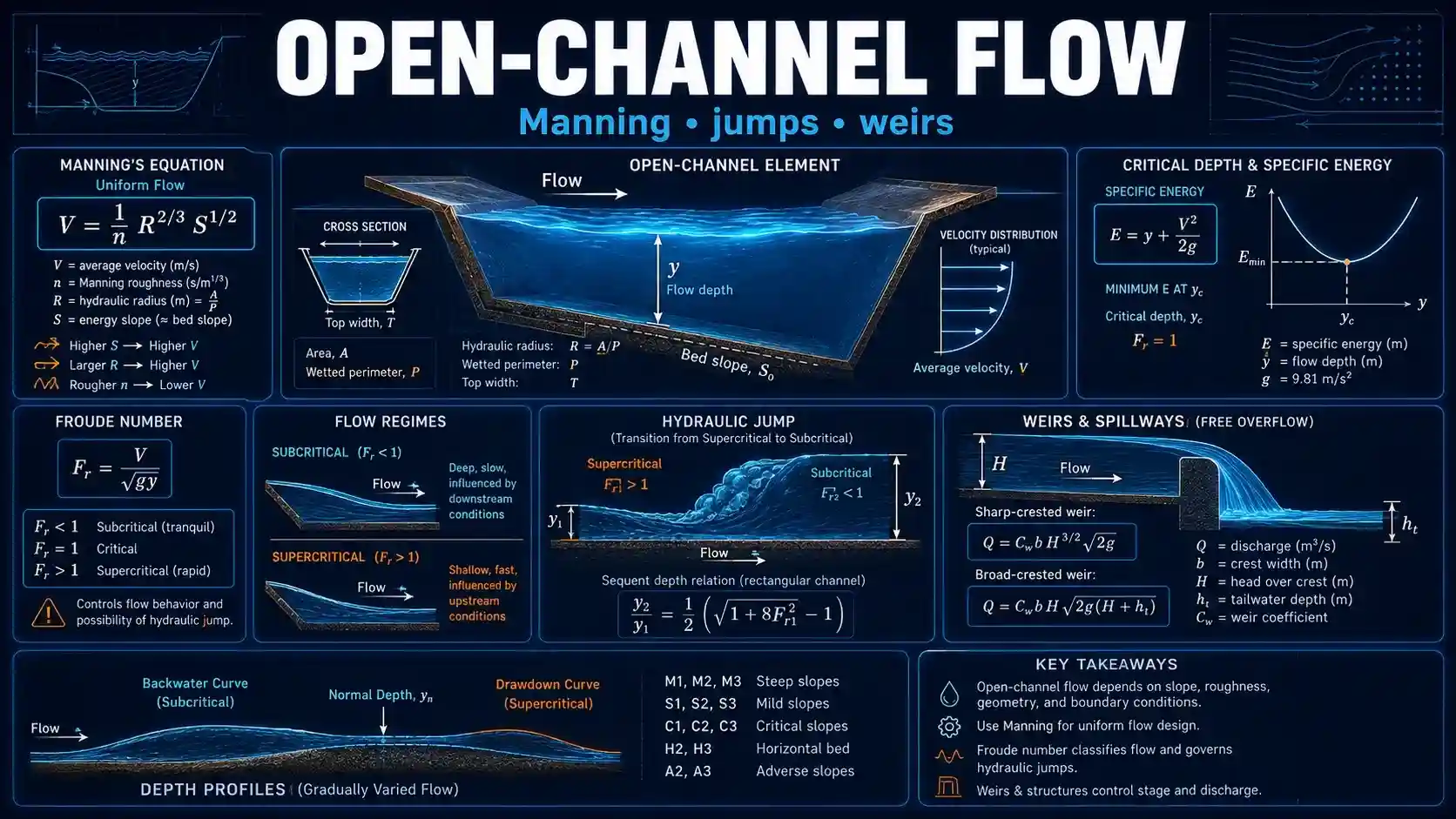
Eleven modules cover rectangular and trapezoidal channel geometry, Manning uniform flow, Froude number and flow regime, specific energy, critical and normal depth, hydraulic jumps, weirs, sluice gates, and specific force.
Critical depth, specific energy, and specific force share the same flow and width basis, so a hydraulic jump can be checked for both energy loss and momentum conservation from one set of inputs.
Calculators and topics covered
- channels
- Manning equation
- hydraulic jump
- weirs
- Froude number
- critical depth
- specific energy
- normal depth
- sluice gate
Core equations
Method and assumptions
Assumptions
- Manning calculations assume steady uniform flow at normal depth in a prismatic channel with constant roughness.
- The channel bed slope is small enough that the depth measured vertically equals the depth normal to the bed.
- Hydraulic jump relations assume a horizontal rectangular channel and neglect boundary friction over the jump length.
- Weir and gate coefficients are user-supplied and depend on geometry, head, and approach conditions.
- Air entrainment, sediment transport, and gradually varied flow profiles are not modelled.
Limitations and design boundaries
- Educational screening calculations only. Real systems require verified fluid properties, calibrated coefficients, uncertainty analysis, applicable codes and standards, and qualified engineering review.
Sources and references
Primary sources are preferred for ratings, standards, manufacturer data, and externally defined constants.
- Çengel and Cimbala, Fluid Mechanics: Fundamentals and Applications
- Munson et al., Fundamentals of Fluid Mechanics