Waves & Sound Calculators and Simulations
Free wave and sound calculators for wavelength, frequency, wave speed, Doppler effect, interference, standing waves, harmonics, and acoustic relationships.
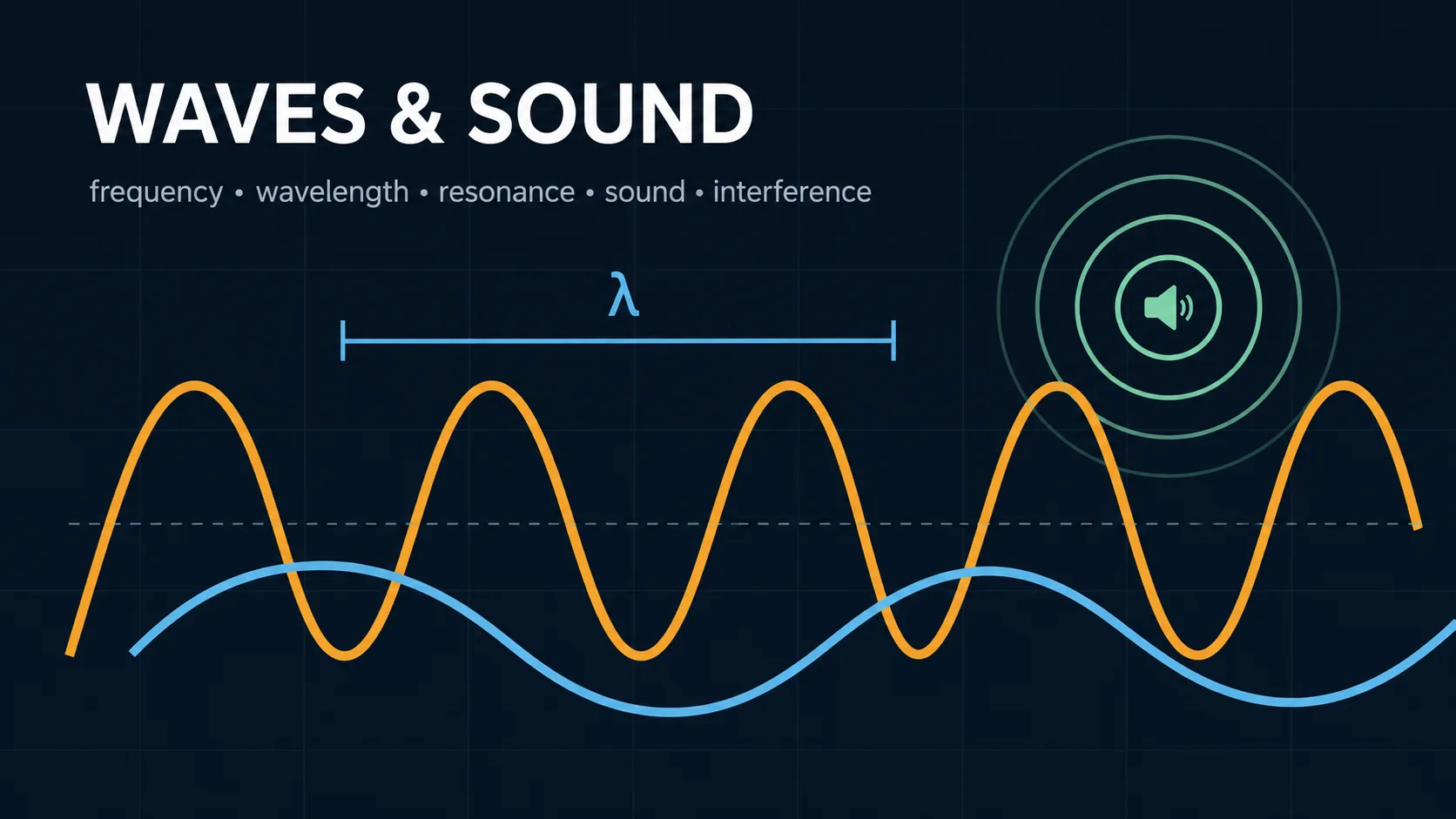
Browser-local interactive workspace
Interactive workspace initializes in your browser. Engineering method, assumptions, validation, and references are available below.
Engineering reference
Waves and Sound: theory, method, and sources
This physics workspace publishes 5 governing equations, 4 stated assumptions, 2 documented boundaries, and 3 sources so the numbers it returns can be checked rather than taken on trust.
Calculations run locallyCalculation & source methodology
How this tool works
Eight focused modules cover introductory wave physics and practical acoustics.
Every visual updates dynamically while the user changes the physical parameters.
Safety limits bound all inputs and drawing workloads.
Calculators and topics covered
- waves
- sound
- acoustics
- Doppler effect
- standing waves
- resonance
- decibels
- wave speed calculator
- Doppler calculator
- standing wave simulator
- string resonance
- pipe resonance
- decibel calculator
- beat frequency
Core equations
wave speed:v=fλDoppler effect:f′=v−vSf(v+vL)string modes:fn=(2L)μTnsound level:β=10log10(I0I)acoustic impedance:Z=ρc
Method and assumptions
Assumptions
- Wave and resonance models are ideal, linear, and one-dimensional unless otherwise stated.
- Doppler calculations use subsonic source and listener speeds.
- Sound-level spreading assumes an isotropic point source in a free field.
- Acoustic reflection assumes normal incidence at a flat boundary.
Limitations and design boundaries
- The workbench does not model nonlinear acoustics, diffraction, broadband spectra, room reverberation, or frequency-dependent material losses.
- Musical-instrument presets are representative educational examples rather than calibrated instrument designs.
Sources and references
Primary sources are preferred for ratings, standards, manufacturer data, and externally defined constants.
- Kinsler, Frey, Coppens and Sanders, Fundamentals of AcousticsSound propagation, intensity and pressure levels, impedance, and resonance.
- Serway and Jewett, Physics for Scientists and EngineersWave relationships, the Doppler effect, standing waves, and beats.
- ISO 1683, Acoustics: Preferred reference values for acoustical and vibratory levelsBasis for the 20 micropascal and 1e-12 W/m2 reference quantities used in the level calculations.
Related Physics tools
Pendulum Forecast LabIntegrate a two to seven arm pendulum with Runge-Kutta and race three statistical forecasters against deterministic chaos.MechanicsFifteen mechanics calculators and simulations covering motion, forces, energy, rotation, oscillations, and gravity.ThermodynamicsFree thermodynamics calculators for ideal-gas relationships, thermodynamic processes, work and heat, cycles, efficiencies, properties, and energy balances.