Thermodynamics Calculators & Interactive Workbench
Free thermodynamics calculators for ideal-gas relationships, thermodynamic processes, work and heat, cycles, efficiencies, properties, and energy balances.
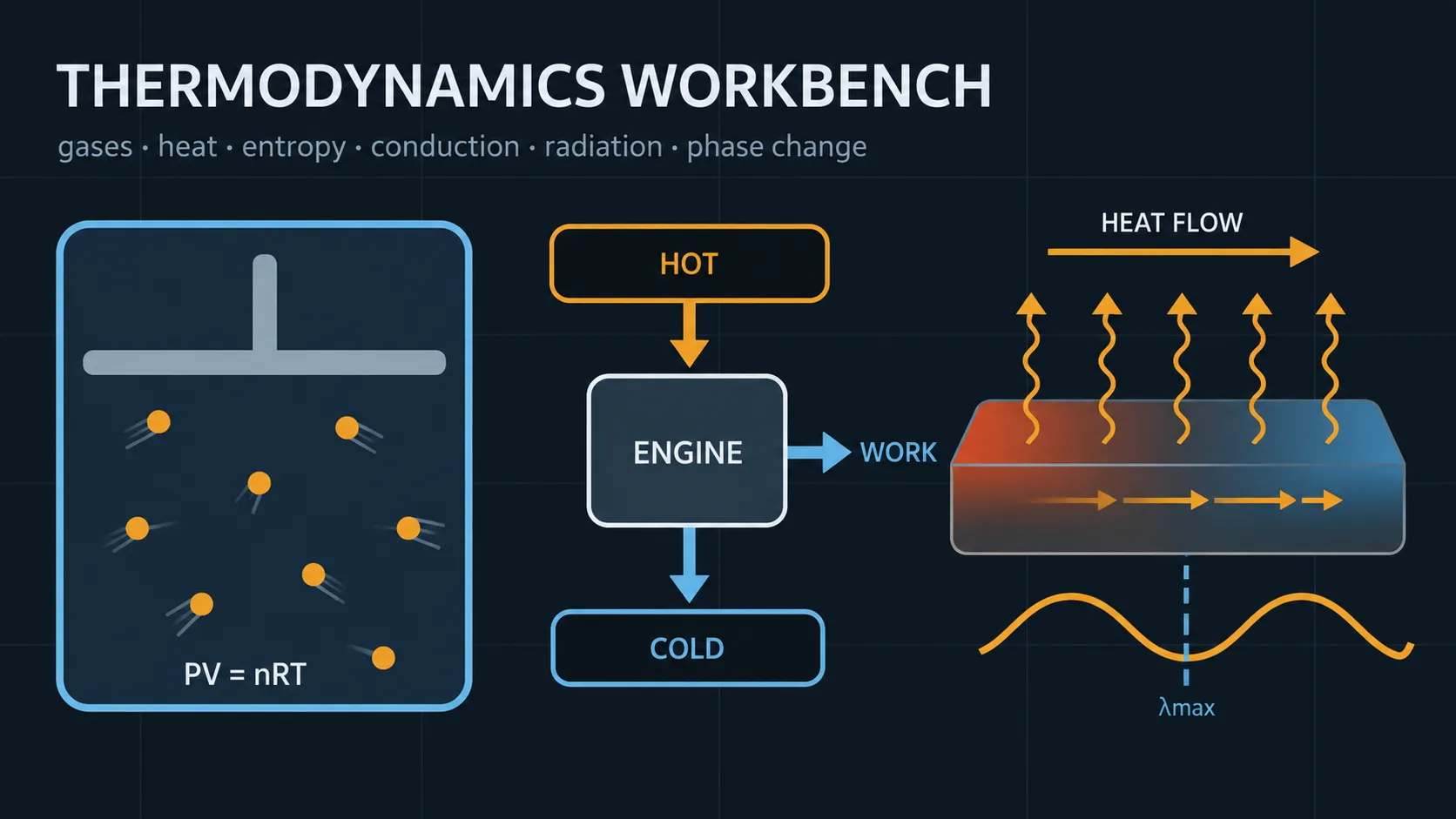
Browser-local interactive workspace
Interactive workspace initializes in your browser. Engineering method, assumptions, validation, and references are available below.
Engineering reference
Thermodynamics: theory, method, and sources
This physics workspace publishes 8 governing equations, 4 stated assumptions, 2 documented boundaries, and 3 sources so the numbers it returns can be checked rather than taken on trust.
Calculations run locallyCalculation & source methodology
How this tool works
The workbench separates nine common thermodynamics models into focused tabs with live reference diagrams.
Every numerical field is safety-clamped before calculation and rendering.
Calculators and topics covered
- thermodynamics
- ideal gas
- heat transfer
- entropy
- Carnot
- conduction
- blackbody radiation
- phase change
- ideal gas law calculator
- specific heat calculator
- thermal expansion calculator
- Carnot efficiency calculator
- entropy calculator
- multilayer conduction calculator
Core equations
ideal gas:PV=nRTsensible heat:Q=mcΔTthermal expansion:ΔL=αL0ΔTCarnot efficiency:η=1TH−TCentropy:ΔS=TQrevormcln(T1T2)layered conduction:Rtotal=kA∑Lthermal radiation:P=εσAT4phase change:Q=mcΔT+mL
Method and assumptions
Assumptions
- Temperature entry can use Celsius or kelvin; gas, engine, entropy, and radiation equations use absolute kelvin. Temperature differences do not receive a Celsius offset.
- Material properties are treated as constant over each selected interval.
- Conduction is one-dimensional and steady-state with perfect layer contact.
- Blackbody calculations use the graybody approximation with wavelength-independent emissivity.
Limitations and design boundaries
- Real gases, transient conduction, convective correlations, detailed spectral emissivity, and multi-phase equilibrium are outside the current models.
- Results are educational estimates and are not safety-critical design certification.
Sources and references
Primary sources are preferred for ratings, standards, manufacturer data, and externally defined constants.
- Çengel and Boles, Thermodynamics: An Engineering ApproachIdeal gas behaviour, heat transfer, Carnot limits, and entropy accounting.
- Moran, Shapiro, Boettner and Bailey, Fundamentals of Engineering ThermodynamicsClosed and open system energy balances and second law analysis.
- CODATA Internationally Recommended Values of the Fundamental Physical ConstantsGas constant, Stefan-Boltzmann constant, and Wien displacement constant.
Related Physics tools
Pendulum Forecast LabIntegrate a two to seven arm pendulum with Runge-Kutta and race three statistical forecasters against deterministic chaos.MechanicsFifteen mechanics calculators and simulations covering motion, forces, energy, rotation, oscillations, and gravity.Waves and SoundFree wave and sound calculators for wavelength, frequency, wave speed, Doppler effect, interference, standing waves, harmonics, and acoustic relationships.