Mechanics Workbench
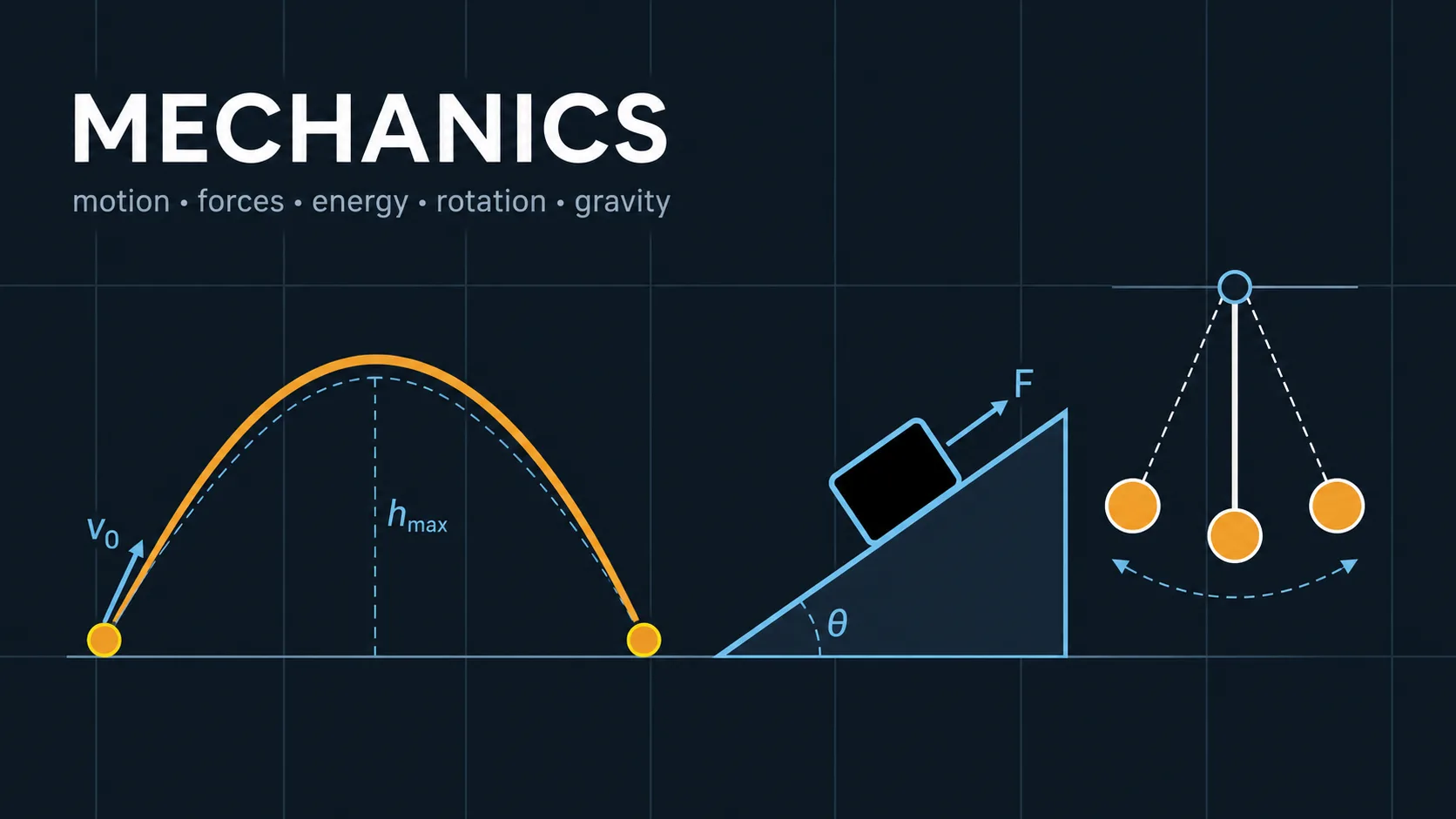
Fifteen mechanics calculators and simulations covering motion, forces, energy, rotation, oscillations, and gravity.
Loading interactive tool…
How this tool works
The Mechanics Workbench separates mechanics from waves and thermodynamics so each physics area can expand independently.
It includes fifteen focused modules with SI-unit inputs, calculated intermediate quantities, and dynamic diagrams for the visual models.
Core equations
kinematics: v_f = v_i + at and Δx = v_i t + ½at²projectiles: x = v₀ cos(θ)t and y = h₀ + v₀ sin(θ)t − ½gt²Newton’s second law: F_net = maenergy: KE = ½mv², PE = mgh, W = Fd cos θ, P = W/tmomentum conservation: Σp_before = Σp_aftercircular motion: a_c = v²/r and F_c = mv²/rtorque and rotation: τ = rF sin θ, α = τ/I, KE_rot = ½Iω²friction: f_s,max = μ_sN and f_k = μ_kNcenter of mass: r_cm = Σmᵢrᵢ / Σmᵢpendulum: T ≈ 2π√(L/g)spring and SHM: F = −kx and ω = √(k/m)gravitation: F = Gm₁m₂/r²escape velocity: v_esc = √(2GM/r)Assumptions
- Inputs use SI units unless the field explicitly displays another unit.
- Projectile motion neglects aerodynamic drag and uses uniform gravitational acceleration.
- Collision models are one-dimensional and isolated from external impulse.
- The pendulum simulator uses the small-angle harmonic approximation.
- Spring and SHM models use an ideal massless spring without damping.
- Escape velocity neglects atmosphere, rotation, propulsion losses, and other bodies.
Limitations
- The tools provide educational and preliminary analytical models rather than safety-critical engineering validation.
- Static and kinetic friction coefficients must be selected for the actual material pair and conditions.
- Large-angle pendulum motion and damped or driven oscillations require more advanced numerical models.
References and verification
- Classical mechanics relationshipsThe workbench implements the conventional Newtonian mechanics equations listed above.