Photonics Workbench
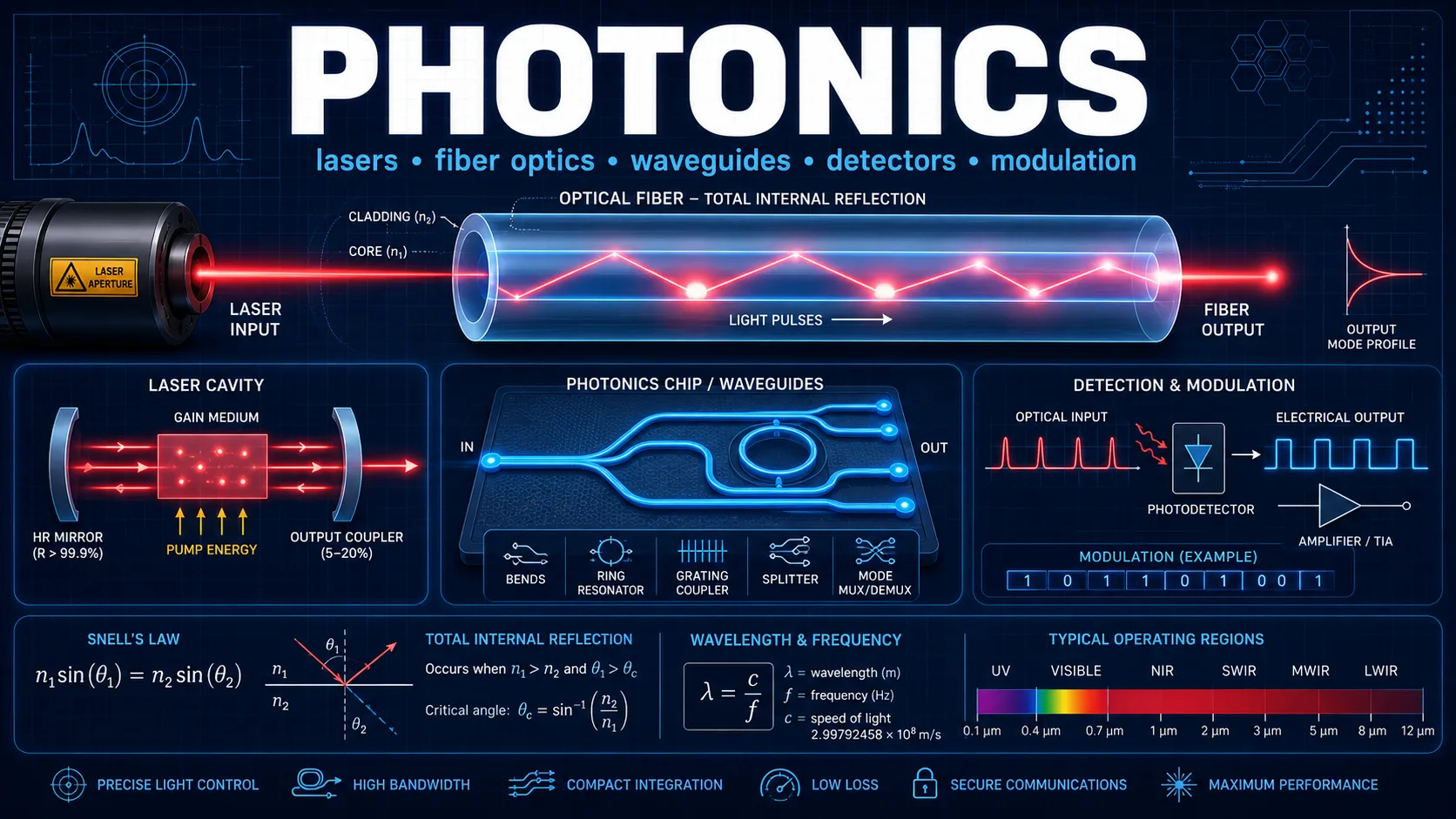
Calculate photon energy, Gaussian beam propagation, fiber modes and link budgets, photodetector response, attenuation, optical cavities, and pulsed-laser quantities.
Browser-local interactive workspace
Interactive workspace initializes in your browser. Engineering method, assumptions, validation, and references are available below.
Engineering reference
Photonics: theory, method, and sources
This optics & photonics workspace publishes 5 governing equations, 3 stated assumptions, 1 documented boundary, and 3 sources so the numbers it returns can be checked rather than taken on trust.
Calculations run locallyCalculation & source methodology
How this tool works
A device-oriented bridge from photon quantities to practical optical sources, fibers, detectors, and resonators.
All quantitative graphs carry explicit units on both axes.
Calculators and topics covered
- photons
- lasers
- fiber optics
- photodetectors
- optical cavities
- Gaussian beam
- numerical aperture
- link budget
- responsivity
- Beer Lambert
- Fabry Perot
- pulse energy
Core equations
E=λhczR=λπw02NA=ncore2−nclad2Prx(dBm)=Ptx−∑lossesFSR=2nLc
Method and assumptions
Assumptions
- Gaussian-beam calculations use an ideal TEM00 beam.
- Fiber mode count uses the weak-guidance step-index approximation.
- Cavity finesse assumes equal mirror reflectivity and negligible internal loss.
Limitations and design boundaries
- These calculators do not replace component datasheets, optical design software, or laser safety analysis.
Sources and references
Primary sources are preferred for ratings, standards, manufacturer data, and externally defined constants.
- Saleh and Teich, Fundamentals of PhotonicsGaussian beam propagation, optical resonators, and photodetection.
- Agrawal, Fiber-Optic Communication SystemsNumerical aperture, normalized frequency, attenuation, and link budget practice.
- Siegman, LasersCavity free spectral range, finesse, and beam quality conventions.
Related Optics & Photonics tools
Geometrical OpticsFree optics calculators and visualizers for thin lenses, mirrors, Snell’s law, refraction, critical angle, magnification, ray diagrams, and imaging systems.Lens Ray SimulatorTrace parallel rays through configurable spherical lens surfaces using Snell’s law and inspect focal behavior and spherical aberration.Wave OpticsSimulate interference, diffraction, gratings, thin films, polarization, optical resolution, and coherence with unit-labeled graphs.