Water & Wastewater Treatment Workbench
Calculate sedimentation, detention, BOD removal, disinfection, activated-sludge loading, SRT, oxygen, sludge, and filtration quantities.
Engineering reference
Water & Wastewater Treatment: theory, method, and sources
This environmental & energy engineering workspace publishes 10 governing equations, 5 stated assumptions, 1 documented boundary, and 2 sources so the numbers it returns can be checked rather than taken on trust.
How this tool works
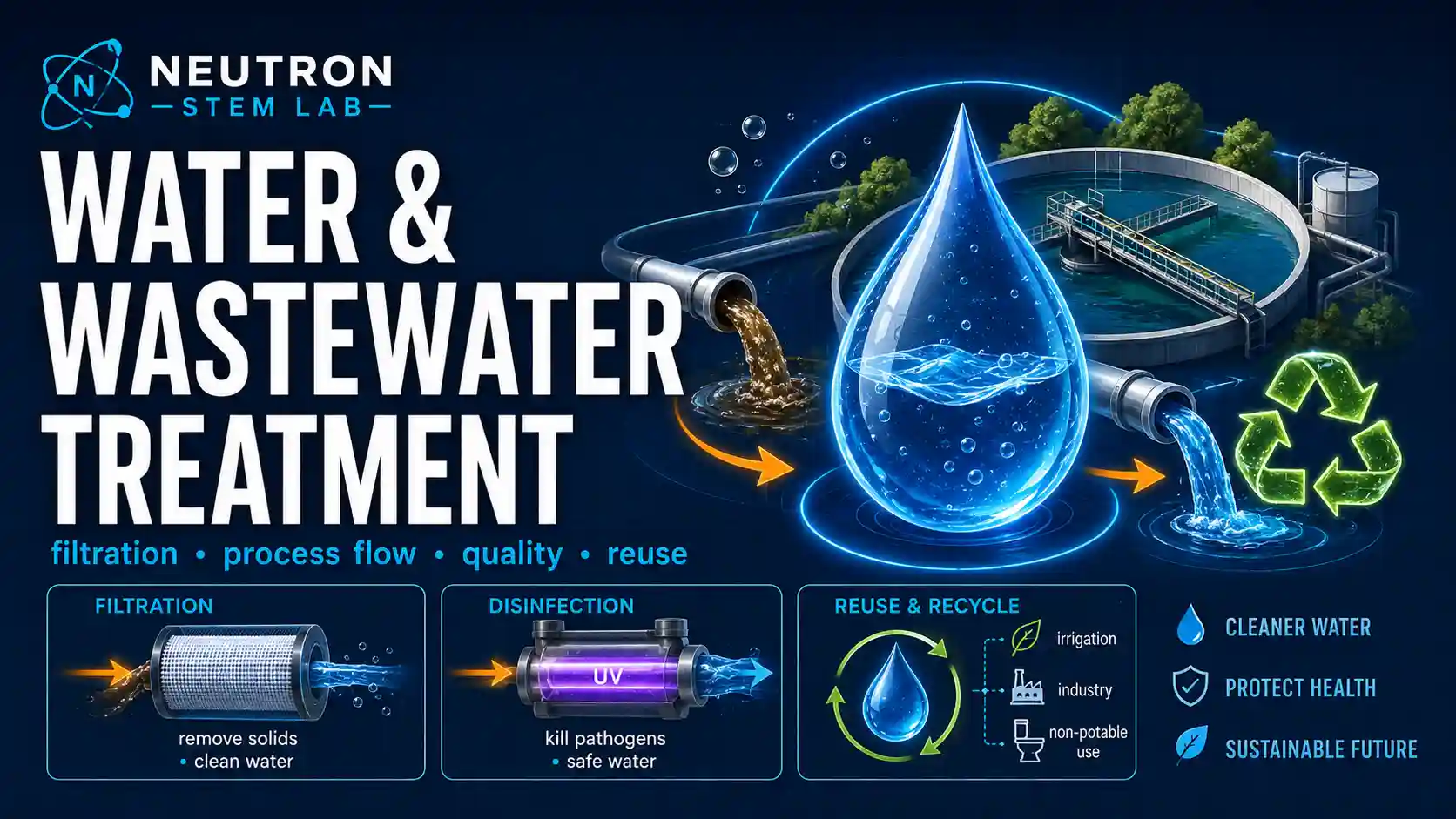
Ten modules cover clarifier surface overflow rate, detention time, BOD removal kinetics, chlorine dosing and CT disinfection credit, activated sludge food-to-microorganism ratio, solids retention time, oxygen demand, sludge production, and filter loading.
The activated sludge modules use the same MLSS and flow basis, so F/M ratio, SRT, aeration demand, and sludge yield can be evaluated as one consistent process design.
Calculators and topics covered
- water
- wastewater
- treatment
- disinfection
- clarifier
- BOD
- activated sludge
- SRT
- chlorine CT
- filter loading
Core equations
Method and assumptions
Assumptions
- Reactors are treated as completely mixed and at steady state; diurnal and storm flow variation is not modelled.
- BOD removal follows first-order kinetics with a single rate constant at the stated temperature.
- CT values must be compared against the correct pathogen, temperature, and pH table from the governing regulation.
- Activated sludge relationships assume a conventional process without nutrient removal or selector zones.
- Yield and decay coefficients are typical literature values and vary with wastewater strength and temperature.
Limitations and design boundaries
- Educational screening calculations only. Treatment design and operation require representative testing, current regulations, redundancy, process controls, safety analysis, and qualified professional review.
Sources and references
Primary sources are preferred for ratings, standards, manufacturer data, and externally defined constants.
- Metcalf & Eddy, Wastewater Engineering: Treatment and Resource Recovery
- AWWA and ASCE, Water Treatment Plant Design