Solid Waste & Life-Cycle Workbench
Analyze waste generation, diversion, landfill capacity, methane, energy recovery, composting, transport emissions, recycling credits, and lifecycle totals.
Engineering reference
Solid Waste & Life Cycle: theory, method, and sources
This environmental & energy engineering workspace publishes 10 governing equations, 5 stated assumptions, 1 documented boundary, and 2 sources so the numbers it returns can be checked rather than taken on trust.
How this tool works
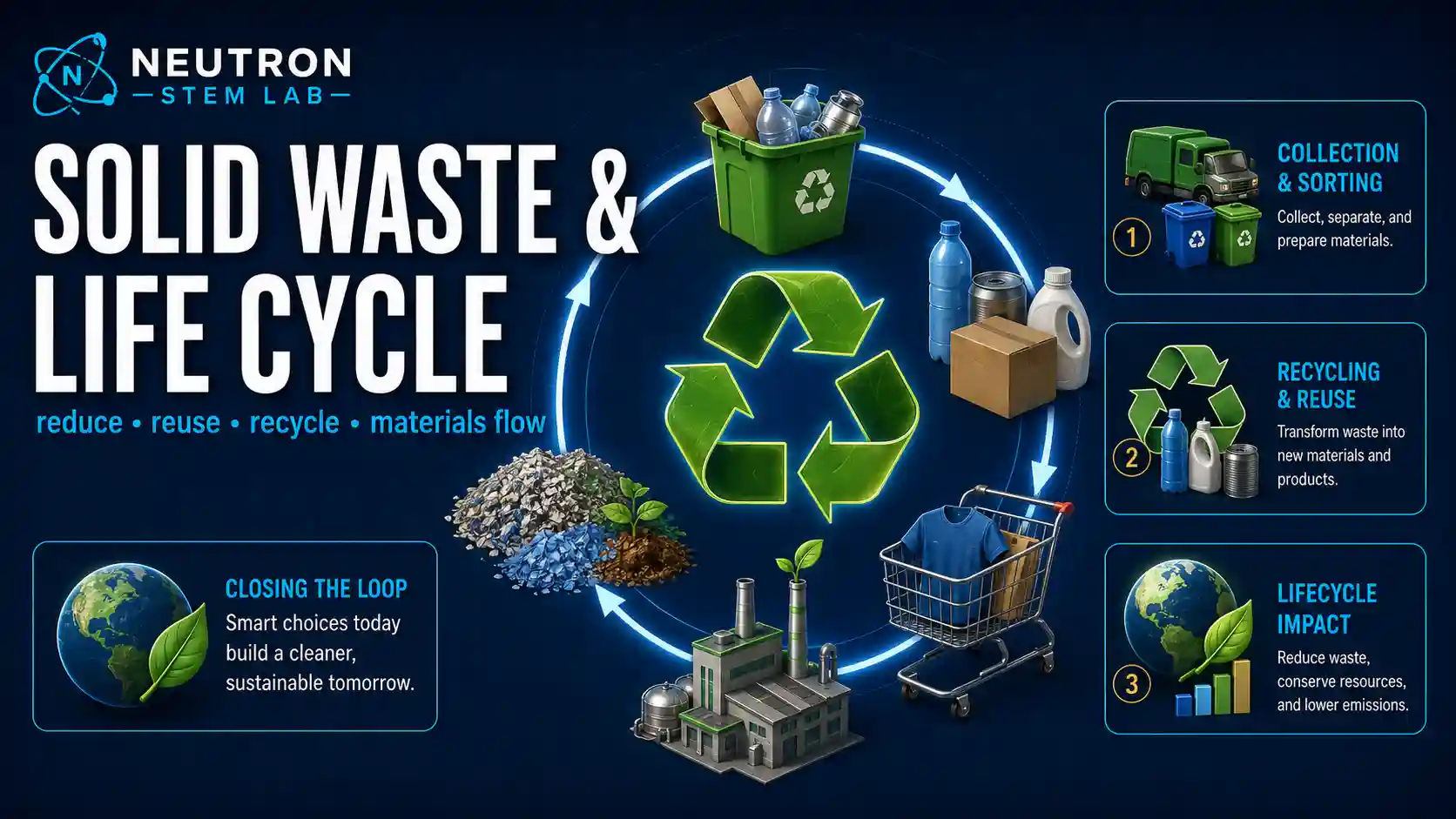
Eleven modules cover waste generation, diversion rates, landfill volume and remaining life, methane generation and gas-to-energy, composting carbon-to-nitrogen ratios, waste-to-energy, transport emissions, avoided emissions from recycling, and a lifecycle total.
The lifecycle module sums collection, processing, transport, and disposal emissions and subtracts recycling credits, which is the net figure that determines whether a diversion programme reduces emissions overall.
Calculators and topics covered
- solid waste
- recycling
- landfill
- life cycle
- waste diversion
- landfill life
- methane
- waste to energy
- LCA
Core equations
Method and assumptions
Assumptions
- Methane generation uses a simple first-order potential rather than a time-resolved decay model such as LandGEM.
- Waste composition is represented by single average values for degradable carbon fraction and heating value.
- Landfill life assumes constant compaction density and a fixed annual growth rate.
- Avoided emission credits depend heavily on the assumed displaced material and regional energy mix.
- Leachate management, long-term aftercare, and land use change are outside the scope of these calculations.
Limitations and design boundaries
- Educational screening calculations only. Waste planning, landfill gas inventories, facility design, and lifecycle assessment require current regulations, representative composition data, documented boundaries, uncertainty analysis, and qualified professional review.
Sources and references
Primary sources are preferred for ratings, standards, manufacturer data, and externally defined constants.
- Tchobanoglous and Kreith, Handbook of Solid Waste Management
- ISO 14040 and ISO 14044 lifecycle assessment framework