Advanced Mathematics Workbench
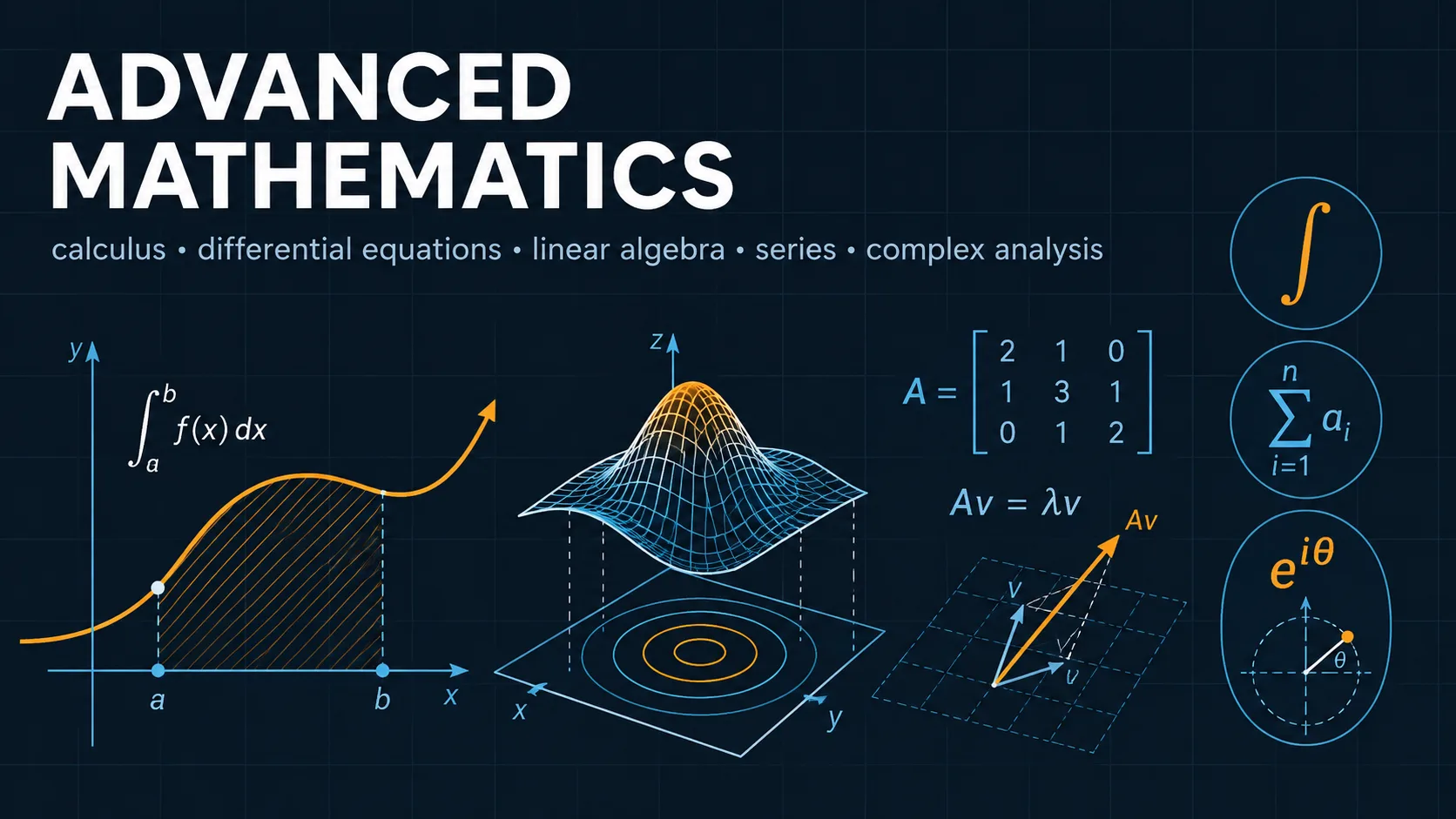
Explore numerical derivatives and integrals, interpolation, polynomial regression, Fourier series, complex numbers, partial fractions, differential equations, Taylor series, and coordinate geometry.
Engineering reference
Advanced Math: theory, method, and sources
This mathematics workspace publishes 4 governing equations, 4 stated assumptions, 4 documented boundaries, and 1 source so the numbers it returns can be checked rather than taken on trust.
How this tool works
This workbench extends the introductory mathematics tool with numerical calculus, approximation methods, data fitting, harmonic analysis, differential equations, and analytic geometry.
Interactive plots support mouse, trackpad, and touch panning and zooming. Inputs update results without rebuilding active form controls.
Calculators and topics covered
- calculus
- numerical methods
- regression
- Fourier series
- differential equations
- complex numbers
- derivative calculator
- numerical integration
- polynomial regression
- Fourier series visualizer
- complex number calculator
- partial fraction decomposition
- Runge Kutta ODE solver
- Taylor series
Core equations
Method and assumptions
Assumptions
- Expression-based tools use radians for trigonometric functions.
- Numerical calculations use double-precision floating-point arithmetic.
- Polynomial regression is limited to degree 8 and Taylor approximations to degree 10.
- The ODE solver handles explicit first-order equations y′ = f(x, y).
Limitations and design boundaries
- Numerical differentiation can amplify noise and cancellation error when the step is too small.
- High-degree interpolation and regression can oscillate or become poorly conditioned.
- The partial-fraction tool currently supports proper rational functions with distinct real linear factors.
- The ODE solver does not automatically detect stiffness or choose an adaptive step size.
Sources and references
Primary sources are preferred for ratings, standards, manufacturer data, and externally defined constants.
- Neutron STEM Lab numerical mathematics engineDependency-free numerical routines implemented for the browser-based workbench and validated with regression tests.