Structural Member Mechanics Workbench
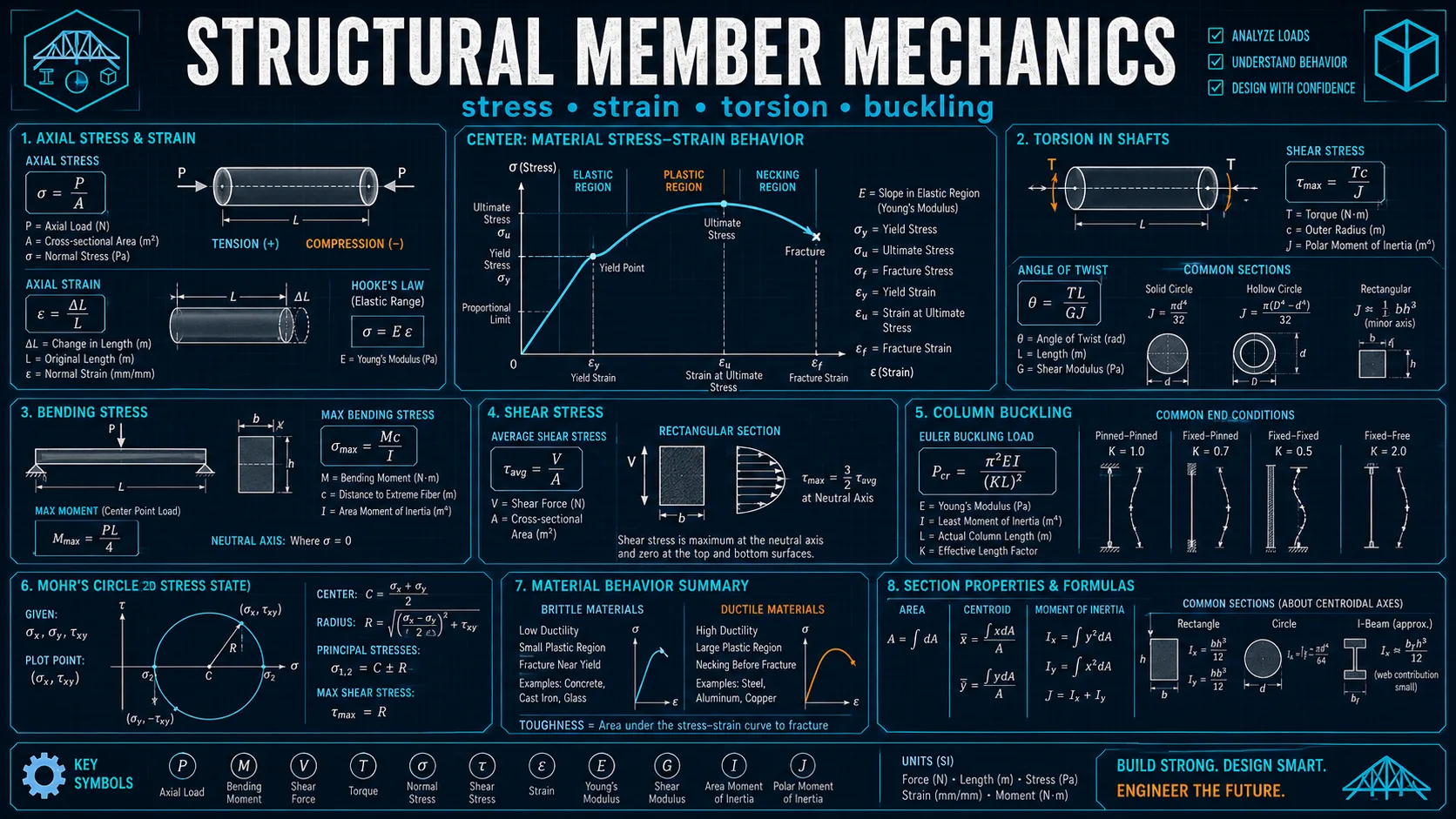
Calculate member stresses, deformations, torsion, thermal restraint, eccentric loading, simplified bolt and weld demands, bearing stress, and utilization.
Engineering reference
Member Mechanics: theory, method, and sources
This civil & structural engineering workspace publishes 10 governing equations, 2 stated assumptions, 1 documented boundary, and 2 sources so the numbers it returns can be checked rather than taken on trust.
How this tool works
Ten modules cover member-level stress checks: bending, transverse shear, torsion, axial deformation, restrained thermal stress, eccentric loading, bolted and welded connections, bearing, and a safety-factor comparison.
The connection modules resolve a load into per-fastener demand and the corresponding shear and bearing stresses, which is the calculation sequence used when sizing a simple shear connection by hand.
Calculators and topics covered
- mechanics of materials
- bending
- torsion
- connections
- stress
- bending stress
- shear stress
- axial deformation
- thermal stress
- bolt group
- weld group
- bearing stress
Core equations
Method and assumptions
Assumptions
- Linear elasticity and idealized load paths.
- Nominal dimensions without local stress concentrations.
Limitations and design boundaries
- Educational mechanics only. It does not implement building-code resistance factors, material specifications, connection detailing, fatigue provisions, fire design, seismic detailing, or professional review.
Sources and references
Primary sources are preferred for ratings, standards, manufacturer data, and externally defined constants.
- Beer, Johnston et al., Mechanics of Materials
- Hibbeler, Mechanics of Materials